Model Legislative Discussion Draft · Version 0.1
The First Amendment
Remedies Act of 2026
A model civil cause of action for First Amendment violations by federal actors, prepared for congressional counsel review.
The one-sentence frame
“Remedies to match rights: if the Federal Government violates your First Amendment rights, the law should give you a meaningful way to defend them.”
Ask your Senators and Representative to introduce this bill.
A model bill only becomes law when a member of Congress introduces it. Use our one-click tool to send this draft to your delegation with a personal message.
The remedial gap this bill closes
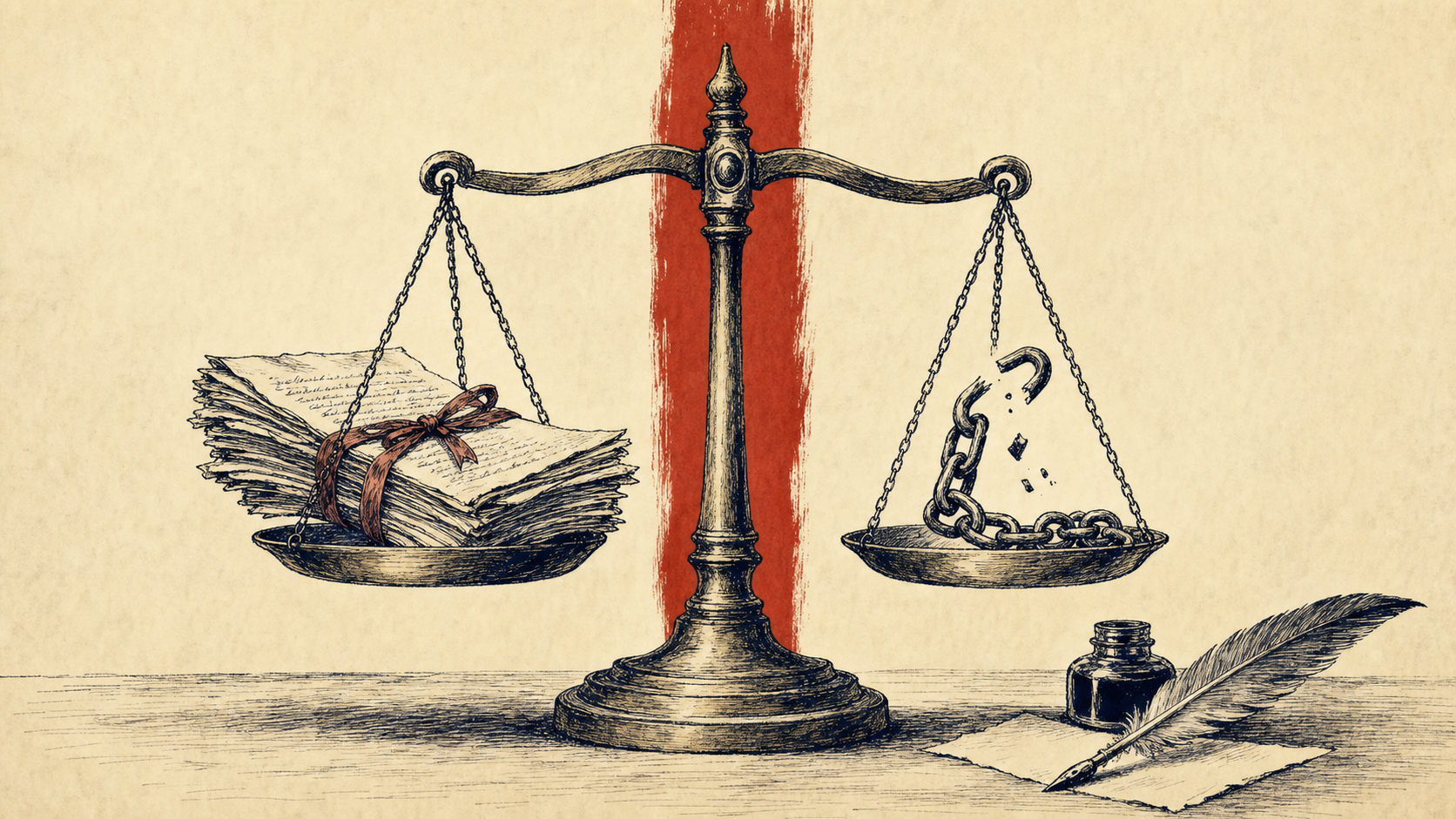
The First Amendment gives Americans the right to speak, publish, worship, assemble, and petition their government. Since 1871, 42 U.S.C. § 1983 has provided an express statutory remedy when state actors violate federal rights. There is no equivalent for federal officers.
For 50 years, courts filled that gap using Bivens v. Six Unknown Named Agents (1971) — a judge-created damages action against federal officers. But the Supreme Court has narrowed Bivens repeatedly, and in Egbert v. Boule (2022) it declined to recognize a Bivens remedy for First Amendment retaliation at all.
What state actors face today
If a police officer, mayor, or state agency violates your First Amendment rights, you can sue them under § 1983. Congress gave you that express statutory remedy 150 years ago.
What federal actors face today
If a federal official does exactly the same thing, there is no equivalent statutory remedy. Judge-made Bivens claims are largely dead for First Amendment cases after Egbert.
This bill fills that gap with the same institutional legitimacy Congress used in 1871 — carefully bounded, viewpoint-neutral, and designed to survive whichever party controls the executive branch when it matters.
Congress passed § 1983 in 1871. It is 155 years overdue for a federal analogue.
Every day this remedial gap persists, federal actors face fewer consequences than state actors for the same conduct. Ask your delegation to introduce this bill.
Section-by-section summary
The draft is short — 18 numbered sections. Each one is deliberately narrow, drafted around current Supreme Court doctrine, and designed to survive the “other-side test” described at the end of this page.
| Sec. | Provision | What it does |
|---|---|---|
| 1 | Short Title | Names the bill. |
| 2 | Findings & Purposes | Explains the constitutional and remedial problem Congress is addressing. |
| 3 | Civil Action | Creates the express federal cause of action; lists available relief. |
| 4 | Covered Conduct | Covers direct federal violations and indirect conduct only when private action is constitutionally attributable to government. |
| 5 | Elements; Causation; Standing | Requires standing, real injury, intent or recklessness for damages, and real causation. |
| 6 | Government Speech Safe Harbor | Protects legitimate government speech, persuasion, information sharing, and lawful referrals. |
| 7 | Damages & Individual Liability | Defines compensatory and punitive damages; keeps sovereign-immunity rules explicit. |
| 8 | Defenses & Immunities | Replaces ordinary qualified immunity for this statutory claim with a tailored good-faith defense — a major policy choice for Congress. |
| 9 | Attorney’s Fees & Costs | Makes meritorious claims economically litigable through fee shifting. |
| 10 | Equitable Relief; Expedited Review | Preserves fast equitable relief where speech loses value with time. |
| 11 | Record Preservation | Creates a records-preservation mechanism after notice while respecting privileges. |
| 12 | Statute of Limitations | Proposes a four-year limitations period with equitable tolling for concealed federal involvement. |
| 13 | Relationship to Other Law | Preserves § 1983, Bivens, and other remedies. |
| 14–15 | Definitions & Private Entity Rule | Defines covered actors; prevents the statute from turning ordinary private moderation into government action. |
| 16 | National Security | Handles classified information without creating a categorical exemption from the First Amendment. |
| 17–18 | Severability & Effective Date | Severability protections and prospective 180-day effective date. |
Download the full draft
14‑page PDF · typeset for review · includes all 18 sections, plain-English summary, key questions for counsel, and cited authorities.
Key policy choices for congressional counsel
This is a discussion draft, not introduced bill text. Several sections raise deliberate choices that require legislative-counsel judgment before markup:
- Constitutional authority. Identify the strongest Article I and structural bases; avoid reflexive reliance on Fourteenth Amendment § 5, which concerns enforcement against the States.
- Defendant architecture. Should damages run against individual officers, the United States through a limited waiver, or both?
- Qualified immunity. This draft (Sec. 8) replaces ordinary qualified immunity with a tailored statutory good-faith defense. Retain, modify, replace, or abolish?
- Mens rea floor. Is reckless disregard the correct threshold for damages, with equitable relief available without that showing?
- Platform / intermediary cases. Codify a specific coercion test, or incorporate evolving Supreme Court state-action doctrine by reference? This draft favors the latter to avoid freezing doctrine prematurely.
- Standing & causation. Draft explicitly around current Article III doctrine so a statutory cause of action does not imply that Congress can eliminate constitutional standing requirements.
- Agency remedies. Consider whether a narrow sovereign-immunity waiver for compensatory damages against agencies is desirable and politically viable.
- Fees. Amend § 1988, or create a standalone fee provision?
- Limitations period. Four years, or another federal limitations period?
- Retroactivity. This draft is prospective. Any retroactive damages provision would require substantially deeper constitutional and reliance analysis.
- Records coordination. Align preservation (Sec. 11) with the Federal Records Act, FOIA, Privacy Act, classified-information statutes, and litigation-hold practice.
- Scope of covered rights. Start with Speech / Press / Petition / Assembly, or cover all First Amendment clauses (adding Religion Clauses) from enactment? Cleanest constitutional symmetry favors all First Amendment rights.
The other-side test
The strongest version of this proposal is not drafted around one administration, one platform, one health controversy, or one set of speakers. It should survive this test:
“Would we still want this statute enforced exactly as written if every relevant federal office were controlled by people with whom we profoundly disagree?”
If the answer is yes, the bill is approaching the constitutional symmetry required for a durable civil-liberties statute. Every provision of this draft was designed to pass that test.
Full text of the discussion draft
Below is the complete text of the model bill as prepared for counsel review. To share the file with a legislative counsel or committee, use the PDF above.
Section 1. Short Title.
This Act may be cited as the “First Amendment Remedies Act of 2026.”
Sec. 2. Findings and Purposes.
(a) Findings.
Congress finds that—
- the First Amendment protects freedom of speech and of the press, the free exercise of religion, the right peaceably to assemble, and the right to petition the Government for a redress of grievances;
- constitutional rights are strengthened when persons whose rights are violated have access to effective and appropriately bounded judicial remedies;
- 42 U.S.C. § 1983 supplies an express statutory cause of action for deprivations of federal rights by persons acting under color of State, territorial, or District of Columbia law;
- no generally applicable federal statute provides an equivalent cause of action for damages for First Amendment violations committed by persons acting under color of federal authority;
- the Supreme Court has recognized limited implied constitutional damages actions against federal officers in certain contexts beginning with Bivens v. Six Unknown Named Agents, 403 U.S. 388 (1971), while cautioning that the creation or expansion of causes of action is ordinarily a legislative function;
- in Egbert v. Boule, 596 U.S. 482 (2022), the Supreme Court declined to recognize an implied Bivens damages remedy for First Amendment retaliation; and
- Congress is institutionally positioned to specify the elements, defenses, remedies, limitations, and safeguards governing a statutory cause of action.
(b) Purposes.
The purposes of this Act are—
- to provide a clear civil remedy for specified violations of First Amendment rights committed under color of federal authority;
- to preserve meaningful declaratory and prospective injunctive relief;
- to authorize damages where a plaintiff proves the elements required by this Act;
- to address unconstitutional governmental use of private intermediaries without treating lawful governmental communication, persuasion, public education, or voluntary cooperation as censorship;
- to protect legitimate law-enforcement, national-security, public-safety, and administrative functions consistent with the Constitution;
- to deter intentional or recklessly indifferent violations while avoiding liability based merely on disagreement with government viewpoints; and
- to establish a viewpoint-neutral remedy available without regard to the plaintiff’s political, religious, scientific, medical, or ideological position.
Sec. 3. Civil Action for Deprivation of First Amendment Rights Under Color of Federal Authority.
(a) Cause of action.
Any person within the jurisdiction of the United States who is subjected, or caused to be subjected, by a covered federal actor acting under color of federal authority, to the deprivation of a right secured by the First Amendment may bring a civil action in an appropriate United States district court, subject to the requirements and limitations of this Act.
(b) Available relief.
A court in an action under this section may award, as appropriate and otherwise permitted by law—
- declaratory relief;
- preliminary or permanent injunctive relief;
- compensatory damages against an individual covered federal actor as provided in section 7;
- nominal damages where permitted by Article III and applicable law;
- reasonable attorney’s fees and litigation expenses under section 9; and
- such other equitable relief as is necessary to remedy a proven violation and is within the court’s lawful authority.
(c) No cause of action against the United States for damages absent express waiver.
Nothing in this Act shall be construed to authorize monetary damages against the United States, a federal agency, or a federal instrumentality except to the extent Congress has otherwise expressly waived sovereign immunity.
(d) Official-capacity relief.
Nothing in subsection (c) shall bar an otherwise lawful action for prospective declaratory or injunctive relief against an appropriate federal officer in an official capacity.
Sec. 4. Covered Conduct.
(a) Direct governmental interference.
A covered violation may include an action by a covered federal actor that, if attributable to the Federal Government under established First Amendment doctrine, unlawfully—
- suppresses or restricts protected speech or publication;
- retaliates against a person for protected speech, press activity, religious exercise, peaceful assembly, association protected by the First Amendment, or petitioning activity;
- imposes a prior restraint prohibited by the First Amendment;
- conditions a federal benefit, contract, grant, license, regulatory treatment, or other governmental advantage on the surrender of a First Amendment right in violation of applicable constitutional doctrine; or
- otherwise deprives a person of a right secured by the First Amendment.
(b) Use of private intermediaries.
A covered violation may also occur where a covered federal actor intentionally causes a private person or entity to take action affecting First Amendment-protected activity and the private action is legally attributable to the Federal Government under governing constitutional state-action doctrine.
(c) Attribution standard.
For purposes of subsection (b), a plaintiff must establish facts sufficient under governing Supreme Court precedent to attribute the challenged private conduct to the Federal Government. Mere communication, criticism, persuasion, information sharing, advocacy, notification of potential legal violations, or a noncoercive request by a federal actor shall not, standing alone, establish attribution.
(d) No expansion of protected speech categories.
This Act creates a remedy; it does not enlarge the substantive scope of the First Amendment. Conduct or expression unprotected by the First Amendment does not become protected by operation of this Act.
Sec. 5. Elements; Causation; Standing.
(a) Elements.
Except for an action seeking solely prospective relief based on an ongoing or imminently threatened violation, a plaintiff seeking damages under this Act shall prove by a preponderance of the evidence that—
- the defendant was a covered federal actor acting under color of federal authority;
- the plaintiff engaged in, sought to engage in, or possessed an interest protected by the First Amendment;
- the defendant intentionally, knowingly, or with reckless disregard for the plaintiff’s clearly established First Amendment rights engaged in conduct constituting a constitutional violation;
- the defendant’s conduct was a factual and legally sufficient cause of the deprivation; and
- the plaintiff suffered legally cognizable injury, except where nominal damages are otherwise available under law.
(b) Causation involving intermediaries.
Where the challenged deprivation was implemented by a private intermediary, the plaintiff must prove both—
- governmental attribution under section 4(c); and
- a causal connection between the covered federal actor’s conduct and the challenged action sufficient to satisfy Article III and applicable First Amendment doctrine.
(c) No generalized grievance.
Nothing in this Act alters Article III standing requirements.
Sec. 6. Lawful Government Communication Safe Harbor.
(a) General rule.
No liability shall arise under this Act solely because a covered federal actor—
- expresses the Government’s own views;
- publicly disputes, criticizes, or responds to speech;
- provides accurate information concerning federal law, policy, threats, emergencies, or government services;
- requests voluntary cooperation without coercion, threat, improper inducement, or exercise of regulatory leverage that would render resulting private conduct attributable to the Government;
- transmits a good-faith referral concerning specific content reasonably believed to violate federal criminal law, pursuant to lawful authority and applicable process; or
- communicates with a private entity in a manner that does not violate the First Amendment under governing Supreme Court precedent.
(b) No categorical immunity.
The form or label of a communication shall not control. A court may consider the totality of the circumstances in determining whether conduct described as a request, referral, recommendation, or information exchange constituted unconstitutional coercion or otherwise rendered private action attributable to the Government.
Sec. 7. Damages and Individual Liability.
(a) Compensatory damages.
A prevailing plaintiff may recover compensatory damages from an individual defendant for injury proximately caused by a violation established under this Act.
(b) Punitive damages.
Punitive damages may be awarded against an individual defendant only upon clear and convincing evidence that the defendant acted with malicious intent to deprive the plaintiff of a First Amendment right or with reckless indifference to a known and substantial risk that the conduct would cause such deprivation.
(c) Government indemnification.
Nothing in this Act requires or prohibits indemnification of a federal employee under otherwise applicable federal law or policy.
(d) Damages against agencies.
No damages shall be awarded against a federal agency under this Act unless separately authorized by an express waiver of sovereign immunity enacted by Congress.
Sec. 8. Defenses and Immunities.
(a) Statutory good-faith defense.
An individual defendant shall not be liable for damages if the defendant proves by a preponderance of the evidence that—
- the defendant reasonably relied on a controlling statute, binding court order, or then-controlling precedent specifically authorizing the challenged conduct; and
- a reasonable federal officer in the same circumstances would not have understood the conduct to violate the First Amendment.
(b) No defense for knowing violation.
The defense in subsection (a) is unavailable where the defendant knowingly violated a binding court order applicable to the conduct or acted with the purpose of accomplishing indirectly through a private intermediary what the defendant knew the Constitution prohibited the Government from accomplishing directly.
(c) Absolute immunities preserved.
Nothing in this Act abrogates an absolute immunity expressly required by the Constitution or recognized by the Supreme Court for functions to which such immunity constitutionally applies, unless Congress expressly provides otherwise.
(d) Qualified immunity.
For claims created by this Act, the statutory defense in subsection (a) shall govern in lieu of judicially created qualified immunity, to the maximum extent constitutionally permissible.
Sec. 9. Attorney’s Fees and Costs.
(a) Prevailing plaintiff.
In an action under this Act, the court shall award a prevailing plaintiff reasonable attorney’s fees and costs unless special circumstances would make such an award unjust.
(b) Prevailing defendant.
A prevailing defendant may recover attorney’s fees only upon a finding that the plaintiff’s action was frivolous, unreasonable, or without foundation.
(c) Conforming amendment option.
Congressional legislative counsel should consider adding actions under this Act to the fee-shifting framework of 42 U.S.C. § 1988(b) rather than maintaining a separate fee provision.
Sec. 10. Equitable Relief; Expedited Review.
(a) Preliminary relief.
A court may grant temporary or preliminary relief under the standards otherwise governing First Amendment cases.
(b) Ongoing digital suppression.
In determining whether irreparable injury exists, a court may consider the time-sensitive nature of speech, publication, petitioning, assembly, electoral discourse, news dissemination, and algorithmically mediated distribution.
(c) Expedited proceedings.
A district court may expedite proceedings where the alleged violation concerns ongoing suppression or an imminent event for which delayed relief would materially impair the exercise of First Amendment rights.
Sec. 11. Record Preservation After Notice of Claim.
(a) Preservation duty.
Upon receipt by a federal agency of written notice reasonably identifying a potential claim under this Act, the agency shall take reasonable steps consistent with federal records law to preserve nonprivileged records materially related to the alleged violation that are within its possession, custody, or control.
(b) No alteration of privileges.
Nothing in this section abrogates a valid constitutional, statutory, evidentiary, classified-information, law-enforcement, or other legally recognized privilege or protection from disclosure.
(c) Remedies for spoliation.
Courts retain their otherwise lawful authority to address spoliation or violation of preservation orders.
Sec. 12. Statute of Limitations.
(a) General rule.
An action under this Act shall be commenced not later than 4 years after the date on which the plaintiff knew or reasonably should have known of the injury and its material governmental cause.
(b) Concealed governmental involvement.
Where material federal involvement was affirmatively concealed and could not reasonably have been discovered, equitable tolling may apply under federal equitable principles.
Sec. 13. Relationship to Other Law.
(a) Supplemental remedy.
Except as expressly provided, the remedy created by this Act supplements and does not displace otherwise available constitutional, statutory, or equitable remedies.
(b) No implied cause of action determination.
Nothing in this Act shall be construed to expand or contract the availability of a cause of action under Bivens or any other implied judicial remedy for claims not brought under this Act.
(c) Section 1983 unaffected.
Nothing in this Act alters 42 U.S.C. § 1983 or remedies available for persons acting under color of State, territorial, or District of Columbia law.
(d) Federal Tort Claims Act.
Nothing in this Act shall be construed to alter rights, exceptions, or procedures under the Federal Tort Claims Act except by express amendment.
Sec. 14. Definitions.
In this Act:
- Covered federal actor. The term “covered federal actor” means an officer, employee, agent, or other person acting under color of federal law or authority, subject to exclusions Congress may specify for constitutionally protected legislative, judicial, prosecutorial, or other functions.
- First Amendment right. The term means a right secured against the Federal Government by the First Amendment to the Constitution as interpreted by the Supreme Court of the United States.
- Private intermediary. The term means a nongovernmental person or entity, including a communications platform, publisher, internet service, artificial-intelligence service, financial intermediary, employer, educational institution, or other private entity.
- Protected activity. The term means speech, press activity, religious exercise, peaceful assembly, petitioning, or other activity protected by the First Amendment under governing law.
Sec. 15. Rule of Construction Regarding Private Entities.
Nothing in this Act—
- converts a private entity into a state actor merely because it communicates or cooperates with the Federal Government;
- creates a general federal right to use or obtain distribution from a private platform;
- restricts a private entity’s own First Amendment rights; or
- imposes liability on a private entity unless liability is independently authorized by applicable law.
Sec. 16. National Security, Classified Information, and Law Enforcement.
(a) Constitutional compliance required.
Nothing in this Act authorizes suppression of First Amendment rights merely by invocation of national security, public safety, foreign affairs, or law enforcement.
(b) Existing protections preserved.
Courts shall apply otherwise valid procedures governing classified information, state secrets, grand-jury secrecy, law-enforcement-sensitive information, and protected intelligence sources and methods.
(c) In camera procedures.
Where necessary and lawful, a court may employ in camera review, protective orders, redactions, or other established mechanisms to adjudicate a claim while protecting information lawfully entitled to protection.
Sec. 17. Severability.
If any provision of this Act, or the application of such provision to any person or circumstance, is held unconstitutional, the remainder of this Act and the application of its provisions to other persons or circumstances shall not be affected.
Sec. 18. Effective Date; Prospective Application.
This Act shall take effect 180 days after enactment and shall apply to conduct occurring on or after the effective date, except that prospective equitable relief may be sought for conduct begun before the effective date that continues after that date to the extent constitutionally permissible.