Restore the First / An explainer · Sept 13, 2026
Why AI is a
First Amendment fight.
Because compute is speech infrastructure — the physical layer through which speech is composed and published at scale — and a federal licensing regime for compute is prior restraint on the First Amendment, no different in principle than a federal licensing regime for printing presses.
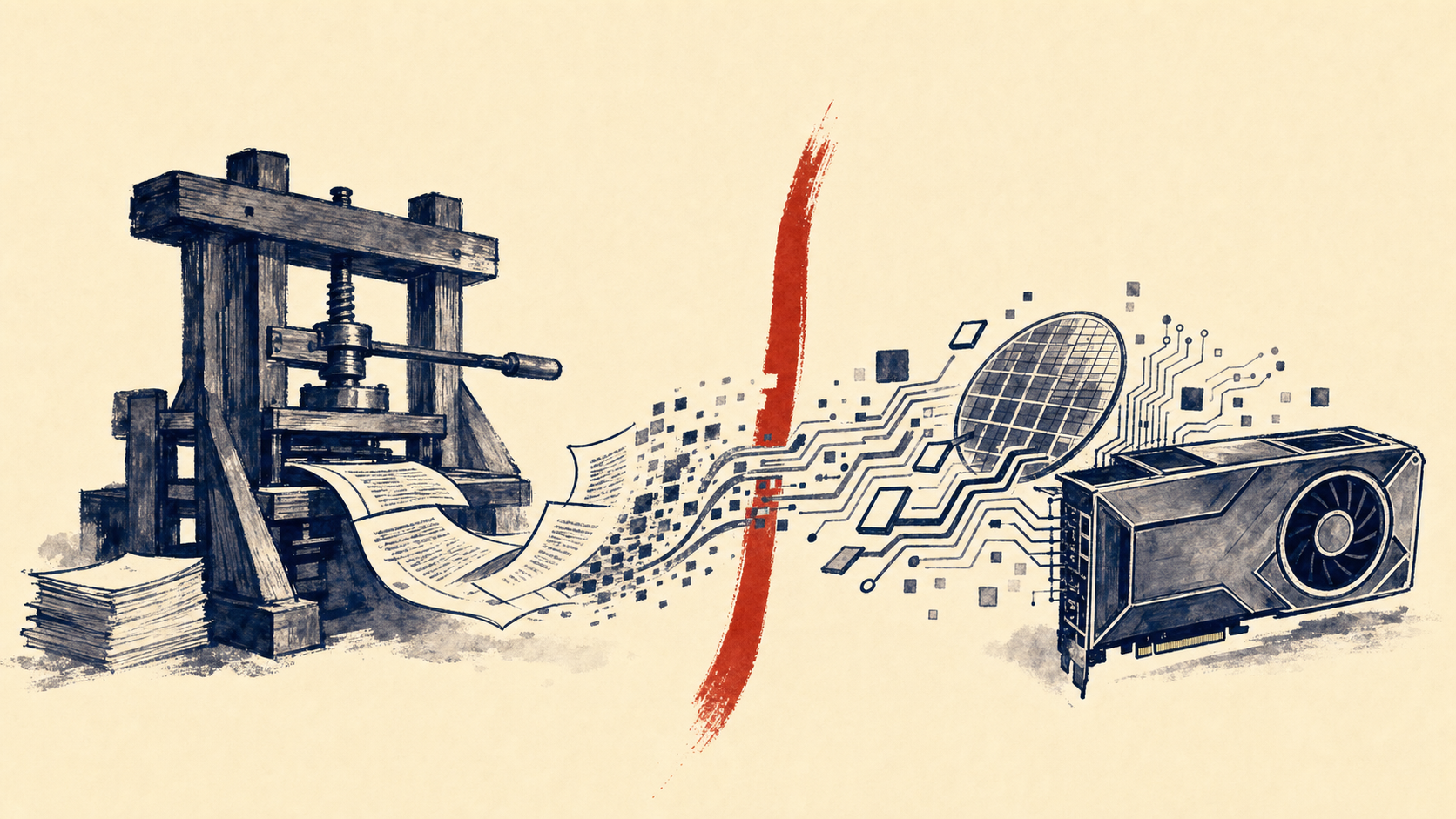
Start with the printing press.
In 1791, when the First Amendment was ratified, the printing press was a physical machine that a citizen could own, operate, and modify. Anyone with the capital to buy the type, ink, and paper could publish. The Free Press Clause — six words: “or of the press” — existed specifically to prevent the federal government from deciding who was allowed to own one.
That is not incidental to the amendment. It is the amendment. The Founders had lived through licensing regimes in which the Crown decided which printers could operate, which manuscripts required a license to publish, and which subjects were beyond permitted discussion. The 1662 Licensing of the Press Act in England had done exactly that; the founding generation wrote the Free Press Clause to make sure the new federal government could never do it here.
In 1791, controlling the press was controlling speech at scale, and controlling speech at scale was a First Amendment question. Both halves of that sentence are still true.
Compute is the printing press of the twenty-first century.
Not metaphorically. Structurally. The printing press was the physical infrastructure through which speech was composed, replicated, and distributed at scale in the eighteenth century. Compute — the servers, chips, and language models on top of them — is that infrastructure in the twenty-first.
Every act of American speech now runs through it. Autocomplete finishes your sentences. AI overviews answer the questions you type into a search bar. AI assistants transcribe your meetings, draft your letters to Congress, translate your voice for the person on the other end of a video call. The model is the printing press; the compute is the physical plant that runs the press; and the model weights are the type in the drawer.
This is not a claim about the future. It is a description of what already happened, everywhere at once, over the last three years. If you use a smartphone, an AI-mediated layer is between you and every other person you communicate with, and every question you ask of the internet.
The next First Amendment battle.
Restore the First put it this way in September 2026:
The next First Amendment battle will not simply concern what you may say. It will concern whether you can access the tools needed to think and speak at scale.
The suppression the coalition’s six named plaintiffs experienced from 2021 to 2024 was output-side censorship: their posts were reduced, their accounts were throttled, their livestreams were removed. Painful and unconstitutional, but downstream.
The regime being built right now is input-side. If two or three federally licensed corporations are the only entities legally permitted to build the AI mediation layer, then the layer through which every future American composes speech will already be filtered before the citizen types a word. The filter is not a takedown. It is a completion. It is what the model offers you when you begin to write. It is the answer the model gives when you ask a question.
Controlling who is allowed to build the model is controlling the answer. Controlling the answer is controlling the speech. And a federal agency with discretionary authority to decide who may build is, by any honest reading, a prior-restraint licensing regime. It is the 1662 Licensing Act with newer chips.
The bill in Congress right now.
On September 3, 2026, Senators Bernie Sanders and Greg Casar introduced the Ban Artificial Superintelligence Act. Sold in its own release as banning “artificial superintelligence” and creating a cabinet-level federal agency to enforce the ban, the bill defines a regulated AI system as one that:
“exhibits or can easily be modified to exhibit capabilities that match or exceed human cognitive performance and capabilities across a broad range of domains or tasks.”
The bolded five-word phrase is the entire policy. A closed-weights model — the kind you get through Anthropic’s or OpenAI’s API — cannot be modified by anyone outside the company. An open-weights model — the kind you can download, run on your own laptop, fine-tune, fork, or build a competing product from — can be modified by definition. That is what “open source” means.
Under the bill’s language, any open-source AI project of any capability level can be classified as regulated at the discretion of a cabinet-level federal agency, and its developers subjected to what the release summary itself calls the “corporate death penalty” — corporate dissolution — and “not more than 20 years in prison.”
The bill does not regulate what AI does. It licenses who is allowed to build it. And the definition is written so that only two or three companies — the incumbents shipping closed-weights systems through APIs — can continue building at all. Everyone else, from a nonprofit lab to a solo developer to a university research group, is either licensed by the new agency or criminalized.
The constitutional equivalent.
The clearest way to see the shape of the problem is to translate it into an analogy the courts have already litigated.
Imagine Congress passed a statute giving a federal agency the power to decide which companies were permitted to manufacture printing presses in America. Not what those presses could publish — only who was allowed to make them. The agency’s stated concern would be public safety; its stated method would be technical review; its stated standard would be that some presses were “too easily modified” to print material the agency deemed dangerous.
Every First Amendment attorney in the country would recognize that as a prior-restraint licensing regime. It does not matter that the statute never mentions speech, never bans a specific publication, never removes a specific work from circulation. The regulation of the infrastructure through which speech is composed and published at scale is itself a regulation of speech — the courts have said so, repeatedly, for two centuries.
The Sanders–Casar bill is that statute, applied to compute. The mechanism is identical. The constitutional question is identical.
“Isn’t this a partisan issue?”
No. And the receipt is in the sponsorship. The Ban Artificial Superintelligence Act is co-sponsored by two of the most progressive members of Congress. The First Amendment coalition organizing against it includes plaintiffs whose original 2021 suppression was directed by a Democratic White House. Both facts are true simultaneously because the underlying question — whether the federal government may license who is allowed to build the infrastructure of speech — is upstream of partisan alignment.
The 1662 Licensing Act was written by a monarchy; the American Free Press Clause was written by revolutionaries. Federal licensing of compute would be enforced by whichever administration held the executive branch when it passed. The person you least want to have that authority is the person the other party elects.
Why this is the sixth pillar.
Restore the First’s original blueprint was organized around the five textual guarantees of the First Amendment: religion, speech, press, assembly, petition. Every one of those five now runs through the AI mediation layer. Religion runs through it when a citizen looks up a scripture reading. Speech runs through it when a citizen drafts an email. Press runs through it when a citizen types a question into a search bar. Assembly runs through it when a group chat uses AI to summarize what people have been saying. Petition runs through it when a citizen signs a document that was drafted by a model whose refusal behaviors were tuned in San Francisco.
If the mediation layer is captured, all five original pillars are captured, silently, at once. That is why, on September 12, 2026, the coalition added a sixth pillar: Speech Infrastructure. Six specific policy asks — from “Keep open source legal” to “Establish a Speech Infrastructure Subcommittee within House Energy & Commerce” — that name what is being protected rather than what happens to be threatening it this quarter.
The pillar is called Speech Infrastructure and not “AI” deliberately. AI is a technology; speech infrastructure is a constitutional category. When the next mediation substrate arrives — neural interfaces, ambient computing, whatever comes after AI — the pillar still stands. The pillar defines what is being protected, not the tool of the moment.
Don’t tread on my compute.
A meme appeared on X on September 12, 2026: the Gadsden flag with the coiled rattlesnake, but the snake was made of stacked circuit boards, and the motto read “Don’t tread on my compute.” It is a joke, and jokes travel; but underneath it is the exact constitutional intuition the Free Press Clause was written to protect.
The rattlesnake on the 1775 Gadsden flag was a warning that certain kinds of interference with certain kinds of freedoms would be met with resistance. The freedom in question at the time was the political liberty of colonies unwilling to be governed by a distant crown. The freedom in question now is the ability of a citizen to think and speak at scale, using tools she is legally permitted to build, modify, and understand.
Both are, at bottom, questions about who owns the infrastructure of self-government. That is what makes them First Amendment questions. That is what makes them the same fight.
Don’t tread on my compute may become the defining civil-liberties slogan of the AI age. It is the twenty-first century restatement of the whole First Amendment.
What to do about it.
Three things, in ascending order of effort:
- Sign the coalition petition. Congress must preserve the records of the last censorship regime, hold public hearings under oath, and create a private right of action so any American penalized by government-directed platform pressure has standing to sue. Under two minutes.
- Read the sixth pillar in the Policy Blueprint. The six asks are drafted so a congressional office can co-sponsor them. Take them to your representative.
- Endorse the coalition publicly, on the record. The Endorsement Kit includes a live card generator with a “Don’t tread on my compute” reason preset, a ready-to-send email template, social copy for X, Instagram, and LinkedIn, and three video-selfie scripts. Under two minutes.
The fight for the last censorship regime is not over — it sits, unruled on, in the Finn docket. But the fight for the next one is being built into the infrastructure right now. This coalition is the one positioned to shape both.
Further reading.
- The Next Censorship Won’t Look Like Censorship — the full coalition statement, Sept 12, 2026. Peer-reviewed evidence base (SEME, ABE, DPE), the funding graph, the operational template.
- Policy Blueprint § 6: Speech Infrastructure — six specific policy asks, drafted for legislative uptake.
- Sanders–Casar Ban Artificial Superintelligence Act — the bill itself. Read the definition section first.
- What Is a Private Right of Action? — sibling explainer on the coalition’s central legislative ask.