Feature · The Licensed Press · September 20, 2026

The press they could not license.

Punishing speech after the fact is slow and needs a jury. Licensing the machine that makes speech is fast and needs only a clerk. The Crown learned that in 1662. It kept the lesson alive in the American colonies for sixty years after England let it go, and the people who wrote the First Amendment were its grandchildren. This is the story of that regime — and of why the bills now proposing to register, evaluate, and switch off the models people think and write with are the same regime, with a new reason attached.

Constitution Day · Three centuries · Web 1, 2, 3 · 1662 → 2026 · The global record · What to do

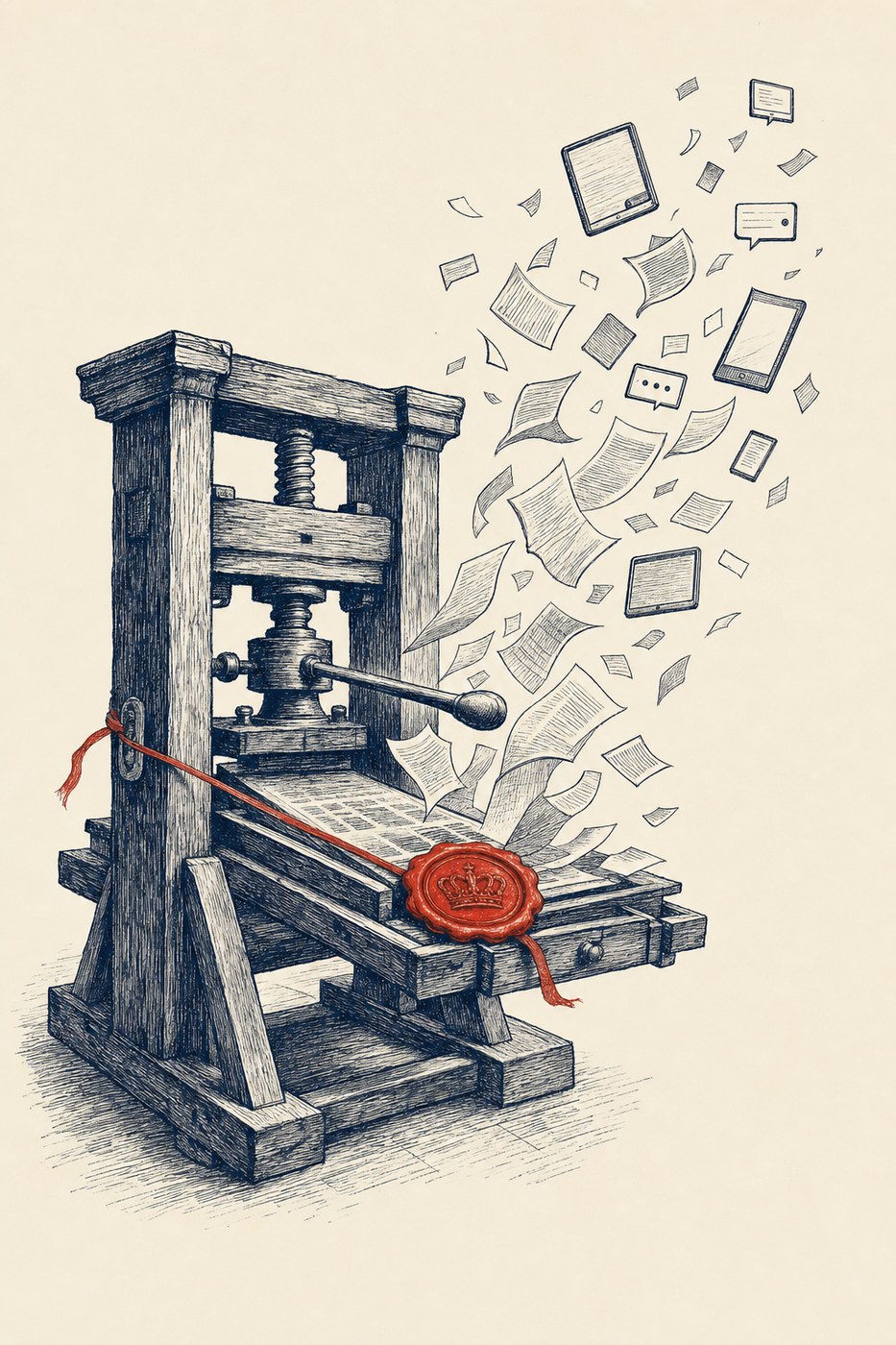
Ink drawing of a seventeenth-century hand printing press with a red wax crown seal and ribbon locked across its bed, while printed pages escape upward and become screens and message windows.
The licensed press. Editorial illustration for Restore the First.

September 17, 2026 · Constitution Day

1787 Philadelphia

Constitution Day marks the signing on September 17, 1787, designated by joint resolution of Congress (36 U.S.C. 106). Four years later the First Amendment: Congress shall make no law “abridging the freedom of speech, or of the press.” Every delegate in that room had grown up in colonies where a press could not lawfully operate without the Crown’s license.

9:54 AM ET · Washington

The media-censorship panel at CHD in DC goes live — Mary Holland moderating; Jan Jekielek, Sayer Ji, Katherine Paul, Polly Tommey, Andrew Wakefield. Sayer Ji, asked about his own eight years as a target, answers with the history: the 1660s, when the king “decided to license printing presses as a way to get even more power over speech, because seditious libel wasn’t working.”

10:22 AM ET

Holland, to the room: “Today, September 17th, is Constitution Day. This is a historic day and this really is about freedom of expression. This is about freedom of speech. This is about freedom of the press.” Twenty-four hours earlier, the Senate Commerce Committee had voted down, 13–15, an amendment to strip AI systems out of the JAWBONE Act — and reported the bill, 18–10. The record →

The argument of this page is not new. It was made on a stage in Washington on Constitution Day, and it was made in Parliament in 1695, and in a Boston print shop in 1723. What is new is that every part of the old regime now has a bill number.

Three centuries of the licensed press

The Crown licensed the machine. Then it licensed America’s.

The dated record, sourced. Read it for the shape: every time punishing speech proved too slow, power moved upstream to the means of speech.

  1. 1643
    Parliament’s Licensing Order. No book, pamphlet, or paper to be printed without prior approval and registration with the Stationers’ Company. John Milton answers the next year with Areopagitica — the founding argument against prior restraint in English. Background
  2. May 19, 1662
    The Licensing of the Press Act. “An Act for preventing the frequent Abuses in printing seditious treasonable and unlicensed Books and Pamphlets, and for regulating of Printing and Printing Presses.” No press without registration; a Crown-appointed licenser; king’s messengers empowered to search for unlicensed presses; fines and prison. Statute history
  3. 1662
    Massachusetts follows. The General Court orders that nothing be printed without approval of two licensers and confines the colony’s presses to Cambridge. Source
  4. 1683
    Virginia’s first press is shut. William Nuthead prints the colony’s laws; the Governor and Council forbid him to print anything further “until the signification of his Majesties pleasure shall be known therein.” The next royal governor arrives instructed to allow no press at all. Encyclopedia Virginia · Library of Virginia
  5. May 29, 1686
    Royal instructions to New York. Governor Thomas Dongan is ordered to permit no one to keep a printing press without his “especial leave and license first obtained.” Schuyler, The Liberty of the Press in the American Colonies
  6. Feb 11, 1695
    England lets it die. The House of Commons refuses to renew the Act. Licensing of the press ends in England. It does not end in the colonies: the governors’ instructions stand. Statute history
  7. 1721–23
    Boston: the New-England Courant. James Franklin publishes without a license. In 1723 the Massachusetts General Court forbids him to print without prior “supervision.” He puts his sixteen-year-old apprentice’s name on the masthead. The apprentice is Benjamin Franklin. Massachusetts Historical Society
  8. Aug 1735
    New York: Crown v. Zenger. With licensing unenforceable, the Crown falls back on seditious libel against printer John Peter Zenger. The jury acquits in minutes, over the judge’s instruction. Prior restraint and after-the-fact punishment have both failed in America. Historical Society of the New York Courts
  9. 1765
    The Stamp Act. Unable to license the press or convict it, the Crown taxes it — a duty on every sheet of newsprint. The colonial press responds by printing the Act with a skull where the stamp should be. Ten years later, the war.
  10. 1769
    Blackstone defines the liberty. “The liberty of the press… consists in laying no previous restraints upon publications.” The definition American courts have used ever since. A license is a previous restraint with a filing fee.
  11. Dec 15, 1791
    The First Amendment. “Congress shall make no law… abridging the freedom of speech, or of the press.” Written by the grandchildren of the licensed press.

What the record shows. Licensing was never primarily about what was printed. It was about who was permitted to own and operate the machine. The licenser, the registry, the messenger’s warrant, and the reach across the water were the instruments; sedition was the reason given. When the instruments failed — 1695 in England, 1735 in New York — power tried taxation, and then lost the argument entirely in 1791.

The colonial entries above are drawn from the standard histories of the American press and from the primary instructions and court records they cite. The 1765 and 1769 entries are general history and are not individually footnoted; the rest are.

From the panel · CHD in DC · September 17, 2026

Read. Read and write. Read, write, and own.

Two passages from Sayer Ji on the Constitution Day media-censorship panel. The first explains what actually happened to publishing between 2000 and 2020 — and why it was, in his words, “a meteor-level event” for centralized media. The second names what is being attempted now, and where it comes from.

Clip · two passages · 21:50–24:07 and 07:33–10:22

CHD.TV is publishing the conference session by session. The panel video will be embedded here the moment it is posted; the transcript below is the record in the meantime.

Source: BoxCast recording of CHD in DC, Sept 17, 2026, media panel segment (recording offset 1:54:08–2:48:26). Timestamps are from the panel file. Quotations are from the broadcast’s English caption track, lightly cleaned of filler, with omissions marked.

21:50 The three webs

“I think that’s important, again, to look at the context from web one, which was read only; web two, read and write; and three is actually read, write and own — or owned media. So what we saw with Substack, for example, it was able to maintain platforming of voices like Doctor Mercola, who ended up shifting his entire archive during the window of deplatforming there. And then literally millions joined and now have a way to speak.”

“So I think what we’re seeing is an evolution towards, again, users and those that are here online actually supporting organizations like CHD directly… Now we do have, momentarily at least, billionaires like Elon Musk who bought X, which has done incredible things for the world because it is the top news app and narratives come to X to die in real time, if you haven’t noticed. Some of them are literally vaporized before the mainstream can consolidate them.”

“So how do we do it? We just simply learn to connect with those we trust and we support them with our attention. It’s an attentional economy as well as with dollars.”

The gloss. Web 1 (roughly 1991–2000) let anyone read. Web 2 (2000–) let anyone write — and that, not the reading, is what broke the institutional press’s monopoly on the room. Web 3, as Sayer uses the term, is not a cryptocurrency slogan; it is ownership: the archive, the list, and the relationship with the reader belong to the publisher, not the platform. Mercola moving a decade of work to Substack during his deplatforming is the case study. It is also the precise capability the licensing model, below, is designed to take back.

07:33 The meteor, and the Crown

“We went from web one, which was read only, to web two around year 2000, which was then write — meaning social media started to emerge as a dominant disintermediating force, where global bodies would try to compete with single organizations or even individuals for the attention of the room. And they were losing in a way that was absolutely traumatic. It was a meteor-level event for mainstream media and centralized media.”

“My experience was a rather long, eight-year-long process of being a target of not just a UK-based apparatus. It’s really a transatlantic sort of set of cut-outs that share in funding among sovereign states like the US and UK… They targeted individuals and groups in a way that we all overtly saw with deplatforming. But what’s happening now is there is an epic battle happening with an attempt to once again lay hold of the printing press for how we produce our thought structures. People go to AI to learn how to think better, speak better, and communicate.”

“What’s happening recently with the whole AI doom controversy is about laying hold of the printing press. Again, not unlike the 1660s, when the king decided to license printing presses as a way to get even more power over speech, because seditious libel wasn’t working. But this is, in many ways, historically a Crown operation.”

The gloss. “Cut-outs that share in funding among sovereign states” is a claim this site documents elsewhere, with names and grant numbers, and does not repeat here without them. The claim that matters for this page is the historical one — and it checks out in more detail than the panel had time for.

The licensed press, 1662 → 2026

The same four moving parts. Now with bill numbers.

Put the 1662 Act beside the AI bills this coalition tracks and the architecture lines up part for part. This is the coalition’s analysis; the statute text and the bill text are both linked so you can judge the fit yourself.

England, 1662

“An Act for preventing the frequent Abuses in printing seditious treasonable and unlicensed Books and Pamphlets, and for regulating of Printing and Printing Presses”

  • No press without registration with the Stationers’ Company — a chartered guild given a monopoly and made responsible for policing its members.
  • A licenser appointed by the Crown — Sir Roger L’Estrange, “Surveyor of the Press” — with pre-publication approval over what could be printed.
  • King’s messengers empowered, on a warrant from the King or a Secretary of State, to enter and search for unlicensed presses.
  • Fines and imprisonment. Repeatedly renewed; lapsed, revived under James II, and finally allowed to die when the Commons refused renewal on February 11, 1695.

14 Cha. 2 c. 33. Statute history · Text and commentary

Washington & London, 2025–26

The same four moving parts, in the bills this coalition tracks

  • Registration of the machine. Developer-registration and compute-threshold regimes that make operating a frontier model a licensed activity rather than a lawful one. Bill matrix →
  • A licenser. “Independent evaluator” frameworks that place a government-designated body between a model and its release — the Sanders–Casar bill names a class of them. The Ban ASI Act →
  • The messenger’s warrant. Shutdown and “kill-switch” authority: the power to enter the system and stop the press, on an executive finding. The Kennedy bill →
  • Reach across the water. A UK regulator asserting authority over speech on American servers, enforced through fines and the threat of arrest — the conduct the D.C. court said it could not review. Foreign censorship →

This column is the coalition’s analysis. Each bill’s text, sponsor, and status is on the linked page; read them and judge the fit.

The argument, stated plainly so it can be disagreed with: a licensing regime for the models people use to read, write, and think is the 1662 Act applied to this century’s printing press. Registration of the machine, a licenser between the writer and the page, a warrant to stop the press, and enforcement that reaches across the Atlantic. Every one of those parts has a bill number now. The reasons offered — sedition then, safety now — are the reasons licensing regimes have always offered. The First Amendment was written by people who had heard them.

That is why this coalition treats AI as a First Amendment fight, why it opposes the bills that license the machine and supports the bill that lets Americans sue when the government leans on the machine’s owner, and why it treats a foreign regulator’s reach into American speech as the same question in a different accent.

The global record · already published on this site

Where the licensing model is coming from, and who is carrying it.

This feature is the frame. The evidence is elsewhere on restorethe1st.com, source-linked and adversarially audited. Each card below is a piece of the historical and global context the panel could only gesture at.

Explainer · updated Sept 15

Why AI Is a First Amendment Fight

Compute is speech infrastructure. A licensing regime for the models people write with is prior restraint on this century’s press. The essay, with a dated addendum tracking the two weeks that proved it.

Investigation · seven pieces

The transatlantic AI-regulation pipeline

From The CCDH Rebrand Nobody Noticed to The AI Bill Bernie Sanders Introduced Was Drafted in London: who funds the alarm, who drafts the bills, and who ratifies them. Convergence, documented — not coordination, alleged.

Bill matrix · US + UK

Four bills, two capitals, one architecture

JAWBONE (support). The Sanders–Casar Ban ASI Act and its “independent evaluator” licensers (oppose). The Kennedy kill-switch (watch). The UK Sobel Bill — evaluator, shutdown, extraterritorial reach, the Online Safety Act pattern (oppose).

Timeline · 16 events

The September 2026 convergence

May 14 to September 16: the funding, the whistleblowers, the endorsements, the bills, and the committee room where an amendment to carve AI out of the JAWBONE Act failed 13–15.

Section · foreign censorship

When the licenser sits in London

UK Ofcom fines an American platform; a federal court says it cannot review the conduct; the GRANITE Act (H.R.10174) would close the gap. The 1686 instruction to New York, in a modern accent.

Coalition statement

The Next Censorship Won’t Look Like Censorship

Why the coalition opened a sixth front on speech infrastructure: the next regime will arrive as safety, standards, and licensing — not as a takedown notice.

Live · S.4749

The JAWBONE Act, and the amendment that tried to remove AI

The first amendment offered against a viewpoint-neutral anti-jawboning bill was one to take AI out of it. The committee said no, 13–15, then reported the bill 18–10. The record, in order, and the next ask.

Policy blueprint

Speech infrastructure: the coalition’s position

Where GRANITE, JAWBONE, and the First Amendment Remedies Act sit in the coalition’s legislative program, and what “no licensing of the press” means when the press is a model.

What this feature does not claim

Not coordination. Where this site describes a transatlantic network of funders, drafters, and intermediaries behind the AI-licensing bills, it describes documented convergence of money, personnel, and method. It does not allege a directed conspiracy, here or elsewhere.

Not against safety. The coalition does not dispute that some AI capabilities carry real risk, or that government may address catastrophic misuse. It disputes that the remedy is a licenser between the writer and the page — the remedy the Crown chose in 1662 and the First Amendment was written to forbid.

Not partisan. The licensing bills have sponsors in both parties and both capitals. The bill the coalition supports is bipartisan. The 1662 Act was passed by a royalist Parliament and let die by a Whig one; the principle survived both.

Transcript fidelity. Panel quotations are from the broadcast’s automatic English captions, lightly cleaned of filler with omissions marked by ellipses. The video, when embedded, is authoritative.