Feature · Lawfare · September 21, 2026

When the courtroom
becomes the weapon.

Censorship used to mean a censor. Today it more often means a summons. A defamation suit built to bankrupt rather than to win. A regulator’s investigation opened the week after a critical article. A privately funded prosecution. An application for a speaker’s arrest made in a foreign court, without notice, over speech that was lawful where it was spoken. And behind a growing share of it: money whose source no court requires anyone to disclose. This section documents the instruments, follows the money, and names the fixes.

What it is · The instruments · The money · A case study · Both ways · What Congress can do

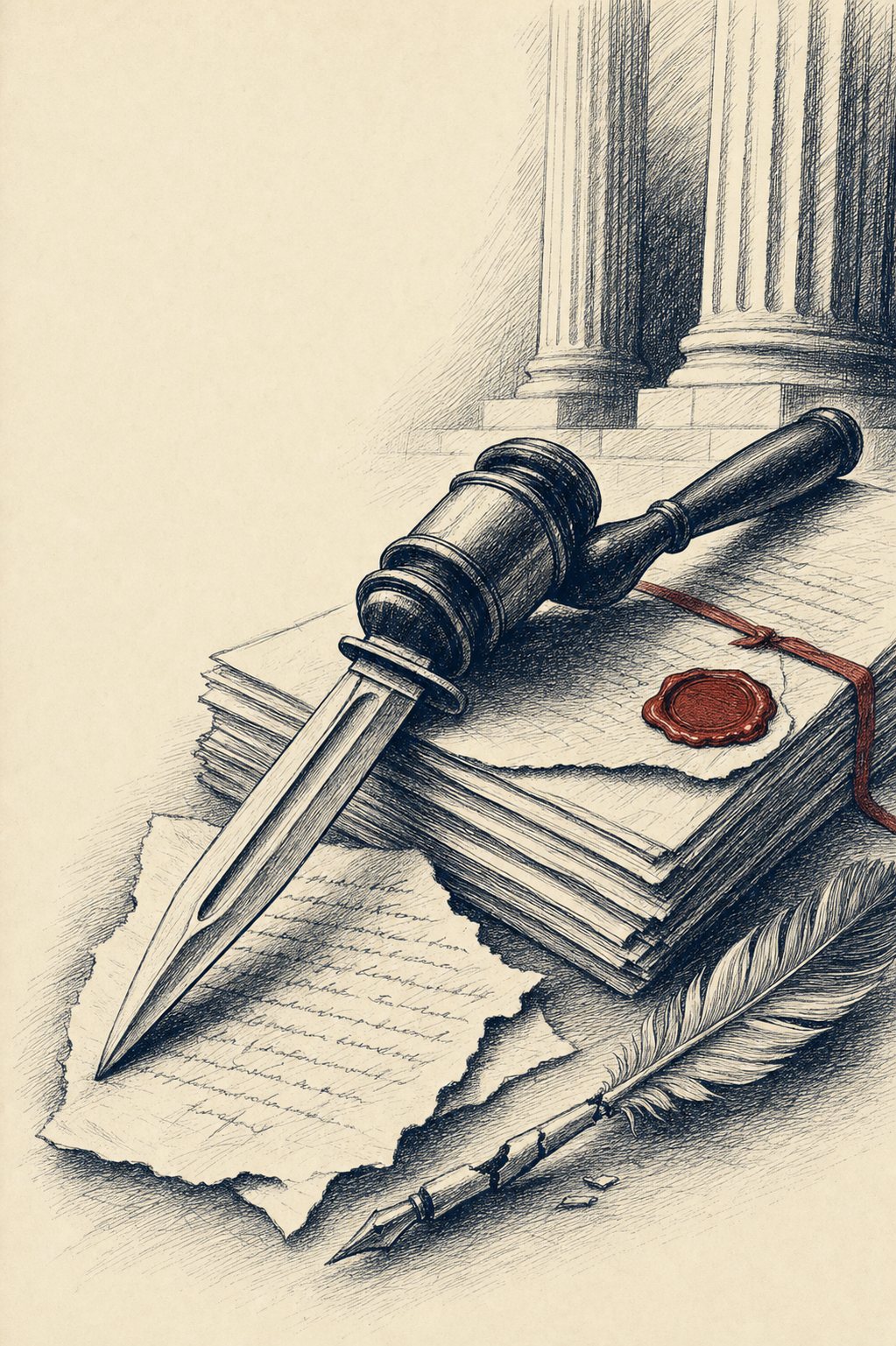
Editorial ink illustration: a judge's gavel whose head has been forged into a bayonet, resting point-down on a torn handwritten page atop a stack of sealed legal filings; a broken quill lies beside it; courthouse columns in the background.
Illustration for Restore the First. Ink on paper.

What lawfare is, in plain language

The word Dunlap, 2001

The modern usage comes from a U.S. Air Force lawyer, Maj. Gen. Charles Dunlap, who in a 2001 Harvard essay defined lawfare as “the use of law as a weapon of war.” He meant states using legal process to achieve what force could not. The definition travels: the weapon is not the verdict but the process — cost, delay, exposure, and fear, applied to a target who did nothing unlawful. Dunlap, “Lawfare 101” ↗

The SLAPP the civil form

A Strategic Lawsuit Against Public Participation is a suit whose purpose is not to prevail but to punish: to force a critic to spend years and a fortune defending speech the plaintiff knows is protected. UNESCO’s October 2025 report found that over 40% of judges and prosecutors surveyed felt ill-equipped to recognize one, and that one-third of media lawyers face barriers — including fear of reprisal — in defending against them. UNESCO, 2025 ↗

The tell process as punishment

Lawfare against speech has a signature. The claim is filed where the speaker is weakest — a foreign forum, an ex parte hearing, a licensing board — not where the facts are strongest. Discovery is the goal, not the means. The funder is hidden. And the case is often lost, or withdrawn, or declined, after the damage is done. As Sayer Ji’s December 2025 statement put it: the procedural logic “does not depend on the content of the speech involved and could be applied to any American whose lawful expression becomes controversial abroad.”

This section is about method, not sides. Several of the defendants in the cases we document are organizations Restore the First has criticized, or that have criticized us. We document them anyway, because the rule that protects a critic we dislike is the only rule that will protect us. See the principle cuts both ways.

How it works · eight instruments

Eight ways to use a court against a speaker.

Every entry below is a documented, dated case — most of them in the last three years. The instruments are different; the effect is the same: the speaker pays for speaking, whether or not anyone ever proves the speech was wrong. Each card links to the docket.

1 · The bankrupting suit

Litigate to extinction

A jury awarded $140 million against Gawker in 2016; the company settled for $31 million and ceased to exist. Peter Thiel later confirmed he had secretly paid $10 million to fund the suits — “less about revenge and more about specific deterrence.”

2 · The headline suit

Sue for a number no one expects to collect

$15 billion against The New York Times; $10 billion against The Wall Street Journal. Both initial complaints dismissed — one for being “unnecessarily lengthy and digressive,” one for coming “nowhere close” to actual malice — and both refiled.

3 · The research suit

Sue the people who study you

X Corp. sued the Center for Countering Digital Hate over its research; a federal judge dismissed it under California’s anti-SLAPP law in March 2024. X’s parallel suit against Media Matters is now in its third year in the Northern District of Texas.

4 · The regulator

Open an investigation after the article

Days after Media Matters published on X, the Texas Attorney General opened an investigation and served a civil investigative demand. The D.C. Circuit affirmed an injunction in May 2025: the complaint stated a justiciable First Amendment retaliation claim.

5 · The license

Threaten the credential, not the speech

Maine’s medical board suspended Dr. Meryl Nass and ordered a psychological evaluation; in August 2026 a federal chief judge let her retaliation claim proceed, writing that the order could be a “retaliatory sanction for disfavored speech.” California repealed its AB 2098 “misinformation” law effective January 1, 2024, while litigation was pending.

6 · The private prosecutor

Let a private firm bring the criminal case

When federal prosecutors declined to charge Steven Donziger with contempt, the judge appointed a private law firm that had done work for Chevron to prosecute him. A UN working group found his detention arbitrary. He served six months after more than two years of house arrest.

7 · The foreign forum

Reach the speaker where the First Amendment does not

Ofcom’s £520,000 fine on 4chan; more than 12,000 arrests in the UK in 2023 under two online-communications offences; an ex parte application in a UK court for an American journalist’s arrest over speech published in the United States. American courts, so far, say they cannot hear the challenge.

8 · The Espionage Act

Charge the publisher, not the leaker

Julian Assange faced 17 Espionage Act counts for publishing; he pleaded to one in June 2024 after seven years in an embassy and five in Belmarsh prison. In September 2026, the Justice Department is in sealed litigation over a reporter’s LinkedIn records in a leak probe — and a federal judge’s non-disclosure order kept the reporter from knowing.

Not on this list: Finn v. Global Engagement Center, the coalition’s own case, dismissed with prejudice on procedural grounds without the court reaching the censorship allegations. It belongs on a different page — the case history — because the problem there was the opposite one: not a court used as a weapon, but a courthouse door that would not open.

Follow the money · third-party litigation funding

Who is paying for the lawsuit against you? Under federal law, nobody has to say.

Third-party litigation funding (TPLF) is the practice of an outside investor — a hedge fund, a sovereign wealth fund, a billionaire, a foundation — paying a plaintiff’s legal costs in exchange for a share of the recovery, or simply for the outcome. The Government Accountability Office told Congress in 2022 that the industry is not regulated under federal law and that no nationwide disclosure requirement exists. Four years later, that is still true.

$0

Federal disclosure required of litigation funders in U.S. courts. The Advisory Committee on Civil Rules has had the question on its agenda since 2014 and has proposed no rule. Committee agenda book, May 2026 ↗

+23%

Growth in new capital committed to U.S. commercial litigation finance in 2025, after two years of contraction, across 39 active funders. Westfleet Insider 2025 ↗

$10M

What Peter Thiel confirmed paying to fund the suits that produced a $140 million verdict and bankrupted Gawker — disclosed only after the verdict, and only because he chose to. TIME, May 2016 ↗

214

Companies — Amazon, Google, Microsoft, Meta, ExxonMobil, Ford, OpenAI, Anthropic among them — that on September 14, 2026 asked the federal rules committee to require funder disclosure. IPWatchdog ↗

1

Sovereign wealth fund — Abu Dhabi’s Mubadala — whose subsidiary took a majority stake in 2024 in Fortress Investment Group, one of the largest litigation funders in the United States. Rep. Cline ↗

Why it belongs in a section on speech. Most litigation finance funds patent and commercial claims, and its defenders are right that it lets small plaintiffs sue large defendants. But the same instrument, pointed at a speaker, is what Professor Lili Levi called in 2017 “a new front in the current war against the media” — billionaire private actors who “clandestinely fund other people’s lawsuits in an attempt to censor press entities.” A funder who profits from a verdict is an investor. A funder who profits from the defendant’s silence is something else, and the court cannot tell the difference if it cannot see the funder. Levi, “The Weaponized Lawsuit Against the Media” ↗

Read the full money page: the market, the players, the disclosure fight, and the bills →

A case study in due process · from a report to an arrest application

How lawful American speech became grounds for an arrest application in a foreign court.

On December 29, 2025, Restore the First’s founder, Sayer Ji, placed on the public record a statement documenting how his lawful U.S. speech was cited to support an ex parte (without notice) application for his arrest and the seizure of his devices in a United Kingdom criminal proceeding to which he was not a party. The presiding judge declined the application in full. The statement is measured, dated, and deliberately limited to what is on the public record. We reproduce its chronology because it is the clearest documented example we have of the pipeline this section is about.

  1. 1
    The label. March 24, 2021: a UK-based organization publishes a report naming twelve Americans over lawful U.S. speech. No contact, no opportunity to respond. Ji statement, timeline
  2. 2
    The privilege. September 2021: the organization’s chief executive relies on that report in testimony to UK parliamentary committees. The corrected transcript records the line: “Anti-vaxxers are like any type of groomer or recruiter.” Statements made under parliamentary privilege cannot be challenged in court. Joint Committee transcript, Q10 ↗
  3. 3
    The migration. May 2025: the speaker learns that a U.S.-published essay and other protected speech have been entered into a foreign criminal proceeding in which he is not a party and has no standing. He objects in writing to authorities in both countries and files a regulatory complaint with the Solicitors Regulation Authority. Ji statement, timeline
  4. 4
    The application. June 9, 2025: “An ex parte (without notice) application was made by a prosecuting party in a UK proceeding seeking authority for my immediate arrest and seizure of devices, despite my status as a non-party and public observer. The application cited my lawful U.S. speech, public associations, and regulatory complaint activity. I received no notice of this application and was afforded no opportunity to be heard. The presiding judge declined the application in full.” Ji statement, verbatim

“I waited months to speak publicly, but continued silence risks letting this become normal — where a foreign organization’s report about American speech can eventually be used to justify arrest applications against Americans in foreign courts.”

— Sayer Ji, A Statement on Due Process, placed on the public record December 29, 2025 and transmitted to the U.S. Department of State, Department of Justice, ODNI, the House Judiciary Committee, and Senate committees via Senator Rubio’s office “for informational and record purposes only.”

The statement expressly does not comment on the merits, evidence, or parties of any underlying proceeding, and neither does this page. Read the full case study, with the statement’s own reservations →

The principle cuts both ways

We defend the procedure, not the plaintiff.

It would be easy to write a lawfare page that lists only the suits against people we agree with. That page would be worthless, because the next suit will be filed by someone we agree with against someone we do not, and the rule we asked the court to apply will be the rule it applies. So this section holds the line in every direction:

  • When X Corp. sued the Center for Countering Digital Hate — an organization the coalition’s founder has litigated against — Judge Breyer dismissed the suit under California’s anti-SLAPP statute as an attempt to punish speech. That was the right result, and we say so. NBC News ↗
  • When the Texas Attorney General investigated Media Matters after it published an unflattering report on X, the D.C. Circuit held the retaliation claim justiciable and left the injunction in place. Right result. D.C. Cir., May 30, 2025 ↗
  • When the President sued the Times for $15 billion and the Journal for $10 billion, two federal judges dismissed the initial complaints — one as “unnecessarily lengthy and digressive,” one for coming “nowhere close” to actual malice. Right results. The refiled suits deserve the same scrutiny. NYT ↗ · Politico ↗
  • When the White House barred CNN, MS NOW, and Politico from coverage on September 18, 2026, the Committee to Protect Journalists called it an “alarming escalation.” Access denial is not litigation, but it is retaliation for speech by the state, and it belongs in the same conversation. CPJ ↗
  • And when Alex Berenson’s jawboning suit against Biden-era officials was settled by the Justice Department in May 2026, that too was a court doing its job — the same job the courts declined to do in Murthy and in Finn. DOJ ↗

What Congress can do · five asks

Five rules that would make lawfare against speech harder to hide and easier to end.

Ask 1 · Sunlight

Disclose who funds the suit.

  • Require disclosure to the court and the parties of any third party with a financial interest in the outcome of a civil action — as the Litigation Transparency Act (H.R. 1109) and Senate bill S. 3826 would do, and as Chief Judge Connolly of the District of Delaware has required in his own cases since April 2022.
  • Preserve the court’s discretion to seal legitimately sensitive terms; disclosure to the judge is the floor.

Status: H.R. 1109 marked up Nov. 19, 2025 but never reported; its successor H.R. 7015 stalled Jan. 13, 2026. S. 3826 pending in Senate Judiciary.

Ask 2 · Sovereignty

No foreign-state money in American lawsuits against American speakers.

  • Pass the Protecting Our Courts from Foreign Manipulation Act (H.R. 2675): bans funding by foreign states and sovereign wealth funds, requires disclosure of any foreign funder, and dismisses with prejudice suits that violate it.
  • Reported by House Judiciary 15–11 and placed on the Union Calendar June 15, 2026. It is ready for a floor vote. It needs one.

Senate companion reintroduced by Sen. Kennedy, Nov. 2025.

Ask 3 · Speed

A federal anti-SLAPP law.

  • Forty states have anti-SLAPP statutes; federal court has none, and the circuits split on whether state laws even apply there. A speaker sued in federal court in the wrong circuit loses the shield.
  • Early dismissal, a stay of discovery, and fee-shifting for suits targeting protected speech — the structure of the bipartisan Free Speech Protection Act introduced by Reps. Raskin and Kiley and Sen. Wyden in December 2024.

Status: introduced in the 118th Congress; we have not identified a federal anti-SLAPP bill introduced in the 119th. IFS state count ↗

Ask 4 · Notice

Notice before coercion, when the predicate is speech.

  • The principle at the center of the December 2025 statement: no American should face an application for arrest, seizure, or restraint grounded in lawful speech without notice and an opportunity to be heard.
  • Domestically, Congress can direct that federal agencies decline to assist foreign coercive process predicated on speech protected here — and can require the State Department to report on such requests annually.

This is a coalition proposal, not a pending bill. Our model text is on the First Amendment Remedies Act page.

Ask 5 · Shield

Do not enforce foreign speech judgments here.

  • The SPEECH Act of 2010 already bars U.S. courts from enforcing foreign defamation judgments that would fail First Amendment scrutiny. It does not reach regulatory fines, orders, or demands.
  • The GRANITE Act (H.R. 10174) would extend the shield to foreign censorship enforcement. Introduced August 27, 2026. Zero cosponsors.

GRANITE is prospective: it would matter if a foreign speech-related judgment, fine, or order were later presented for U.S. recognition or enforcement. CRS on the SPEECH Act ↗

What we are not asking

Not a ban on litigation funding. Not a ban on defamation suits.

  • Litigation finance lets inventors, small businesses, and injured people sue defendants who can outspend them. That is a good thing, and the funders’ trade association is right to say so. We are asking for sunlight, not prohibition.
  • Defamation law protects real people from real lies. Sullivan does not stop a public figure from winning; it stops a public figure from winning without proof. We want that standard defended, not lowered.

ILFA’s opposition statement ↗ — read the other side.

What this section does not claim

Not a comment on any live proceeding. Where this section refers to Sayer Ji’s December 29, 2025 statement, it reproduces only what that public statement says, and adopts its reservations: it does not reference, analyze, or opine on the merits, evidence, or parties of any underlying proceeding, and is not made in coordination with any party to one.

Not a claim that any plaintiff acted in bad faith. We describe suits, investigations, and applications by their public procedural history — filed, dismissed, refiled, declined, affirmed — and quote the judges. Whether a given suit was a SLAPP is a legal conclusion a court reaches; we report those conclusions where courts have reached them.

Not against litigation funding, and not legal advice. The coalition’s position is disclosure, not prohibition. Nothing here is legal advice; if you are facing a suit over your speech, the Reporters Committee’s anti-SLAPP guide is a good first stop.

Descriptive as of September 21, 2026. Bill statuses, cosponsor counts, and case postures change. Each fact carries its source inline; where a source is a news report rather than a court document, we say so on the docket page.