Lawfare · Due process: a case study · September 21, 2026

Not charged. Not served.
Not a party. Not told.

On December 29, 2025, Sayer Ji — founder of GreenMedInfo and of this coalition — placed on the public record a statement documenting how his lawful speech in the United States was cited, in June 2025, to support an ex parte application for his arrest and the seizure of his devices in a United Kingdom criminal proceeding to which he was not a party. The judge declined the application in full. This page reproduces the statement’s dated chronology, its reservations, and the one principle it asks for. It adds nothing that is not in the statement itself.

Why this case · The chronology · Non-party consequences · The principle · On the record · What this page is not

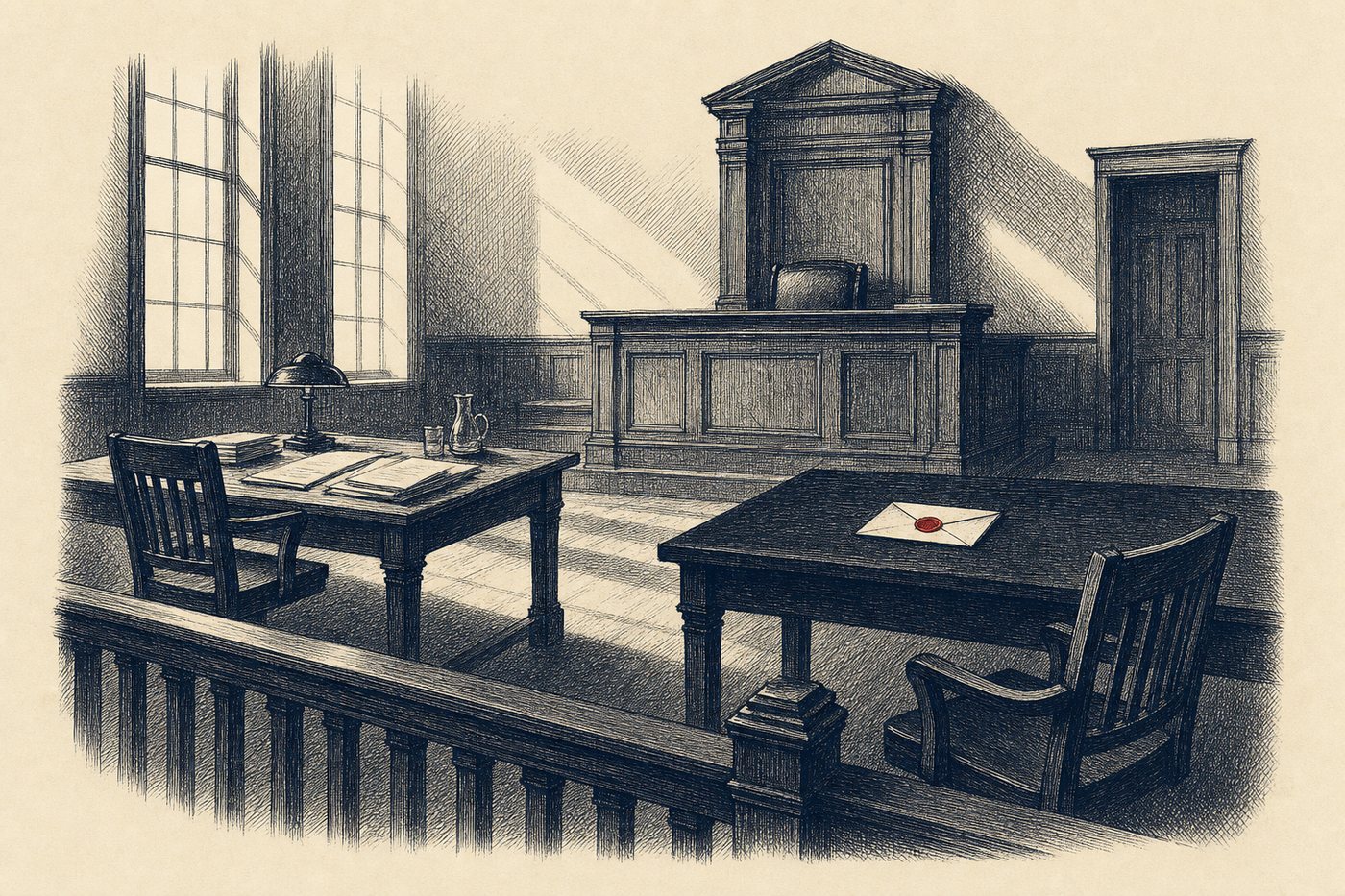
Editorial ink illustration: a spare courtroom seen from the gallery; one counsel table is set with papers and a lamp, the other is bare except for a single unopened envelope sealed in red wax, its chair pushed back and empty.
Illustration for Restore the First. The empty table is the non-party’s.

Why this case, and why in these words

Documented on the record

Most lawfare is hard to document because the target cannot see the file. Here the sequence is on a public court record: the statement notes that during public proceedings on December 1–3, 2025, the June 9 arrest application concerning him was referenced on the record. The statement was then transmitted to the U.S. State Department, the Justice Department, ODNI, the U.S. Embassy in London, the House Judiciary Committee, and the Senate Foreign Relations and Intelligence Committees via Senator Rubio’s office.

Restrained by design

The statement is written the way a coalition for the First Amendment should write: every event carries “per available documentation,” the chronology disclaims motive and causation, and it declines to name or characterize the parties to the underlying case. We hold to the same discipline. The only person named on this page is the author.

Transferable to anyone

The statement’s central claim is not about its author. It is that the procedural logic “does not depend on the content of the speech involved and could be applied to any American whose lawful expression becomes controversial abroad.” That is why it belongs in a section on lawfare, and not only in a founder’s biography.

Full text: A Statement on Due Process, placed on the public record December 29, 2025 and published to X the same day. An editorial note dated January 3, 2026 points to a separate public-record update on oversight escalation; the statement itself is preserved as originally published.

The chronology · reproduced from the statement

From a report about American speech to an application for an American’s arrest: four years, seven steps.

The statement introduces its timeline with a sentence we reproduce because it governs how to read what follows: “The following chronology is provided solely to establish sequence and timing. It does not assert motive, causation, or legal conclusions, and it should not be read as expressing any view on the merits of any referenced proceeding.” Where we add a source, it is a public document the statement itself points to.

  • Before 2021
    Per the statement: media investigations and “risk-rating frameworks operating outside any judicial or regulatory process” had already characterized segments of independent health-related speech “as adjacent to extremism, misinformation, or public harm” — without notice, evidentiary standards, or adversarial testing — producing “reusable reputational classifications” capable of migrating across platforms and institutions.
  • Mar 24, 2021
    The UK-based Center for Countering Digital Hate publishes the “Disinformation Dozen” report, identifying the author “based on lawful U.S. speech.” He “was not contacted or afforded any opportunity to respond.” See the coalition’s Named-Target Record ↗
  • Sep 2021
    In written and oral testimony to UK parliamentary committees, the organization’s chief executive “repeatedly relied on the ‘Disinformation Dozen’ report to characterize named U.S. citizens, including myself, using analogies to organized criminal networks, sexual groomers, and actors responsible for loss of life.” The statement adds: “These analogies appear in parliamentary records; I do not interpret or endorse their intent.” The corrected transcript of the September 9, 2021 session records, at Q10: “Anti-vaxxers are like any type of groomer or recruiter.” Statements made under parliamentary privilege cannot be challenged in court. Joint Committee on the Draft Online Safety Bill, corrected oral evidence ↗
  • May 5, 2025
    The author publishes a long-form essay on a U.S.-based platform “describing my personal experience with CCDH-affiliated censorship and reputational harm.”
  • May 28–29, 2025
    He becomes aware that “this U.S.-based publication and other protected speech had been entered into a foreign criminal proceeding in which I was not a party, had no standing, and received no prior notice.”
  • May 30, 2025
    He transmits “formal written correspondence to relevant authorities in the US and UK objecting to the use of my protected speech in a foreign legal context.”
  • Jun 1, 2025
    He files a formal complaint with the Solicitors Regulation Authority, “Britain’s independent legal profession regulator, raising concerns regarding cross-border legal ethics and due-process standards.” He confirms the filing publicly on June 6.
  • Jun 9, 2025
    “An ex parte (without notice) application was made by a prosecuting party in a UK proceeding seeking authority for my immediate arrest and seizure of devices, despite my status as a non-party and public observer. The application cited my lawful U.S. speech, public associations, and regulatory complaint activity. I received no notice of this application and was afforded no opportunity to be heard. The presiding judge declined the application in full.”
  • Dec 1–3, 2025
    “During public court proceedings in the underlying case, the June 9 arrest application concerning me was referenced on the record, making these procedural events part of the public court record.”
  • Dec 29, 2025
    The statement is placed on the public record and transmitted to U.S. authorities “solely for purposes of record-keeping, oversight, and situational awareness.” It records that, as of that date, “no ongoing proceedings involving me are known.”

All speech referenced “was created and published on U.S.-based platforms, while I was physically present in the United States, and was lawful under U.S. law at the time it was made.”

The statement, emphasis in original.

The non-party problem

The burdens of a defendant, without a defendant’s rights.

The statement’s sharpest section is also its shortest. The author was, in his words, “Not charged. Not served. Not named as a party.” And yet: “this resulted in exposure to an ex parte application for arrest and device seizure, without notice or an opportunity to be heard. In practical terms, this imposed significant burdens typically associated with party status, absent the corresponding procedural protections.”

Two features of the account make it a lawfare case study rather than a grievance. First, the predicate was speech and lawful oversight activity, not alleged conduct: the statement says the application cited “my lawful U.S. speech, public associations, and regulatory complaint activity.” On the last point the statement is emphatic — filing a complaint with a professional regulator “is a lawful and protected act under both U.S. and UK professional oversight frameworks and is routinely available to any member of the public,” and its citation as grounds for arrest “represented a significant departure from ordinary expectations regarding the treatment of non-party regulatory engagement.”

Second, the asymmetry was jurisdictional. “Within the United States, the conduct described would not support an arrest application absent notice, standing, and adversarial testing. When repurposed abroad, however, the same material was treated by a prosecuting party as sufficient to justify physical restraint.” That is the mechanism this whole section is about: the same words, moved to a forum where the speaker has no rights, acquire a procedural force they could never have at home.

The principle the statement argues for

Notice before coercion, when the predicate is speech.

The statement does not ask for a remedy in the underlying proceeding, and neither do we. It asks that a pattern be seen: “a foreign organization’s report about American speech can eventually be used to justify arrest applications against Americans in foreign courts.” The coalition draws from it one rule and three practical asks.

The rule

No American should face an application for arrest, seizure, or restraint grounded in lawful speech without notice and an opportunity to be heard.

  • This is the ordinary rule at home. The statement’s point is that it stopped applying the moment the speech crossed a border in someone else’s file.
  • It is content-neutral. It protects a speaker whose views we share and one whose views we reject in exactly the same way, because it says nothing about the views.

The statement: “The durability of constitutional rights depends on whether procedural protections endure when speech becomes contested, cross-border, or inconvenient.”

Three asks that follow

What U.S. institutions can do without touching any foreign court.

  • Decline to assist. Congress can direct that federal agencies not provide assistance — data, service, extradition support — for foreign coercive process whose stated predicate is speech protected by the First Amendment. This is the logic of the SPEECH Act, extended from judgments to process.
  • Report. An annual State Department report on foreign requests and applications targeting Americans over U.S.-lawful speech, so the pattern is counted rather than anecdotal.
  • Shield, prospectively. The GRANITE Act (H.R. 10174) would bar U.S. recognition or enforcement of foreign censorship judgments and orders. It is not a remedy for a declined 2025 application; it is relevant if a foreign speech-related judgment, fine, or order is ever presented for enforcement here. Zero cosponsors as of this writing.

Model text for the first two asks is on the First Amendment Remedies Act page. These are coalition proposals, not pending bills.

On the record · where the statement went

Transmitted “solely for purposes of record-keeping, oversight, and situational awareness.”

The statement lists the U.S. offices to which it was sent. We reproduce the list because it is the practical meaning of “on the record”: the account is now in the files of the agencies that would handle any future request of the same kind.

  • U.S. Department of State — Office of the Legal Adviser; Bureau of Democracy, Human Rights, and Labor; Office of the Under Secretary for Civilian Security, Democracy, and Human Rights.
  • U.S. Embassy, London — Political and Consular Sections.
  • U.S. Department of Justice — Office of International Affairs; Criminal Division (Public Integrity Section); Office of the Attorney General.
  • Office of the Director of National Intelligence — Civil Liberties and Privacy Office.
  • U.S. House Committee on the Judiciary — Majority and Minority Counsels; U.S. Senate Committee on Foreign Relations and Senate Select Committee on Intelligence — via the office of Senator Marco Rubio.
  • Department of Homeland Security (Office for Civil Rights and Civil Liberties); Department of Health and Human Services (Office for Civil Rights); Department of Commerce (Bureau of Industry and Security).

Nine months later, on September 17, 2026, the author introduced Restore the First from the stage at the CHD in DC conference. The two documents are of a piece: the statement is the record; the coalition is what one does with it. Watch the talk ↗

What this page is not

Not a comment on any proceeding. The statement says of itself: it “addresses only my personal experiences and procedural concerns as a non-party; it does not reference, analyze, or opine on the merits, evidence, or parties in any underlying proceeding” and “is not made on behalf of, in coordination with, or in consultation with any party, witness, legal representative, or interested person in any such proceeding.” This page adopts every word of that. It names no party, no counsel, no court, and no case, and takes no view on any of them.

Not a claim about anyone’s intent. The statement records that the application was made “by a prosecuting party” and declined by the judge. It does not assert why the application was made, and neither do we. Where the parliamentary transcript is quoted, it is quoted verbatim from the official corrected record, without characterization.

Not privileged, not new. The statement is based “solely on publicly accessible materials and my direct experiences, without access to or reliance on non-public information.” Everything on this page is in the public statement or in the public documents it cites.

Published under U.S. law. As the statement says of itself: “published under U.S. First Amendment protections and … not directed at any foreign audience or proceeding.” All rights reserved by the author; affiliations listed for identification only.