Featured partner project · Stand for Health Freedom · September 20, 2026

The First Amendment ends
at the ballot box.

Restore the First is the case, the coalition, and the legislation. But a court order and a bill are only as durable as the people who hold office when the next law is written. Our sister coalition Stand for Health Freedom has built the ballot-box arm of this fight: Vote for Health Freedom — a nonpartisan, single-issue voting bloc that finds, vets, and endorses candidates who will defend bodily sovereignty, informed consent, parental rights, and the freedom to refuse a mandated medical intervention without retribution. We’re featuring it here because it is the electoral extension of our fundamental principles, and because our members should know it exists.

The project · Where it aligns · How it works · Where our lanes differ · Shared history · What to do

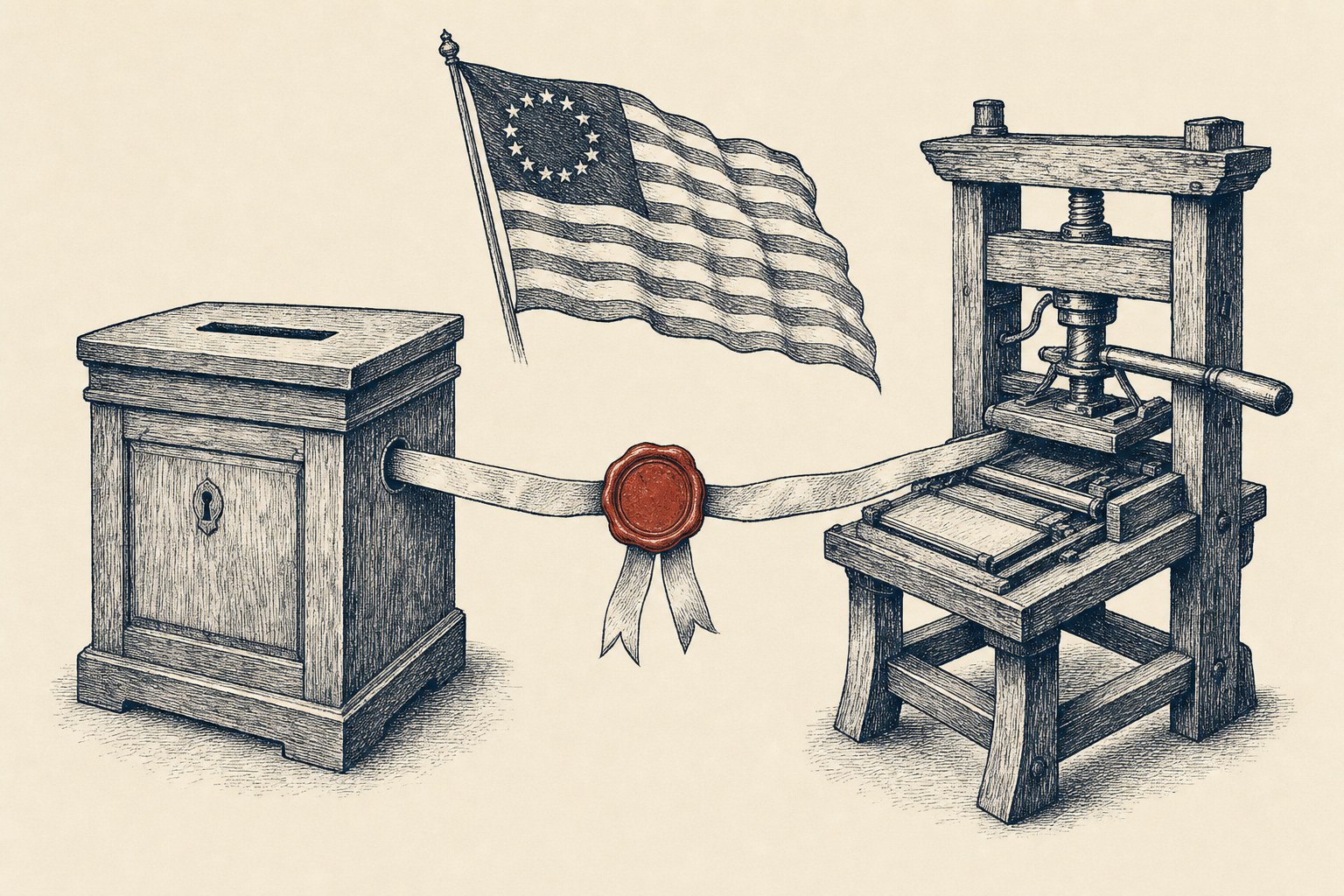
Editorial ink illustration: a ballot box beside a printing press, red wax seal breaking, both under the same American flag.

The project we are featuring

One belief the bloc’s frame

“Stand for Health Freedom is a nonpartisan, single-issue voting bloc united by one belief: health freedom belongs to everyone.” SHF supports candidates who defend health freedom — regardless of party, ideology, or other endorsements — and works across the aisle to unite Americans around health freedom as a shared priority. That framing is compatible, line for line, with our own coalition’s posture: viewpoint-neutral, bipartisan by design, targeted at the underlying right rather than any partisan container for it.

One tool Vote for Health Freedom

The initiative gives voters state-specific endorsements, interviews, voter guides, and a state selector so a voter in any state can find who to support in their own races. Endorsements to date named on the project page include Sen. Sine Kerr (AZ), Sen. Dan Sullivan (AK), Rep. Warren Davidson (OH), Rep. Harriet Hageman (WY), and other candidates at state and local levels. State voter guides listed include Delaware, Rhode Island, New Hampshire, Massachusetts, Connecticut, Wyoming, Missouri, Hawaii, Minnesota, and New York.

One address where to go

The full project, with the state selector, the endorsements, and the guides, lives at standforhealthfreedom.com/vote. Everything below is our framing of why it matters to the Restore the First coalition, why we’re pointing our readers to it, and where our lanes do and do not overlap. The endorsements, guides, and voter tools themselves are SHF’s work — not ours — and remain their editorial responsibility.

Where it aligns with our fundamental principles

The same underlying right, at two ends of the same fight.

Restore the First is a case, a coalition, and a legislative program aimed at speech infrastructure — the platforms, models, and pipelines through which Americans think, write, and publish. Vote for Health Freedom is an electoral program aimed at the medical-decision arm of the same underlying right: the freedom to make informed decisions about one’s own body and one’s children, without government coercion. Below, six places where the two projects run on the same axis, as we read the record.

  1. 1
    Nonpartisan, viewpoint-neutral posture. Restore the First backs the JAWBONE Act because it is viewpoint-neutral anti-jawboning: it forbids federal officials from pressuring platforms to remove lawful speech regardless of the speech’s political direction. SHF’s Vote for Health Freedom applies the same rule at the ballot: it endorses across party lines, based on the candidate’s record on the underlying right, not their partisan container. Same principle, different surface.
  2. 2
    Freedom from coercion by federal actors. The Restore the First litigation is about federal officials pressuring platforms to silence lawful expression. The Health Freedom program is about federal, state, and institutional actors coercing Americans into medical decisions they have not freely consented to. Both name the same architectural problem — state coercion of an individual right — on different fronts.
  3. 3
    Informed consent as a First-Order value. Informed consent is a foundational premise of both projects. In our frame, it is the reason a citizen must be able to hear all sides on a public question before making up their mind — and so cannot be censored out of that decision. In SHF’s frame, it is the reason a patient or parent must be able to weigh evidence for and against a medical intervention — and so cannot be lied to, silenced, or punished for choosing otherwise. Same idea, two applications.
  4. 4
    Local action, national coordination. Restore the First’s policy blueprint pairs federal legislation with state private rights of action. SHF’s program pairs federal endorsements with state directors and local advocates — county commissioners, school boards, sheriffs, city councils — who take the same principle to municipal-level ordinances. Neither coalition believes Washington alone can settle the question.
  5. 5
    Coalition through the same networks. The two projects already share people, allies, and institutional history. Restore the First’s founder Sayer Ji is a co-founder of Stand for Health Freedom. SHF partners named on the Vote page include the Georgia Coalition for Vaccine Choice, Health Freedom Louisiana, the Birth Rights Bar Association, National Health Federation, Autism Trust USA, Children’s Health Defense, and GreenMedInfo. Several are also allies of our coalition. This is not a merger; it is two coalitions on adjacent fronts, refusing to duplicate each other.
  6. 6
    Missouri v. Biden as connective tissue. SHF’s Advocacy Director Jill Hines is a plaintiff in Missouri v. Biden, the landmark federal-jawboning suit that reshaped how courts view government pressure on platforms. That case is legal cousin to Finn v. Global Engagement Center, the litigation this coalition was formed around. Same doctrinal territory. Same defense of the same First Amendment. Different plaintiffs, same underlying record.

What alignment does not mean. Restore the First’s scope is speech infrastructure and the First Amendment. Our coalition takes no institutional position on any specific medical intervention, mandate, exemption regime, or public-health decision. We are featuring Vote for Health Freedom because the underlying rights framework is the same, and because the electoral arm SHF has built is missing from our own program by design. Alignment on principle, division on scope.

What the Vote for Health Freedom project actually gives voters.

Descriptive, not editorial. Everything below is what the project page shows a voter who lands on it today; the language is theirs, our summary.

01 · State selector

Pick your state, get your ballot.

The project’s primary call to action is “Use your voice”: choose a state and receive state-specific endorsements, interviews, and voter guides. Ten state guides are currently listed (Delaware, Rhode Island, New Hampshire, Massachusetts, Connecticut, Wyoming, Missouri, Hawaii, Minnesota, New York), with more added as elections approach.

02 · Endorsements

Named candidates, not vague slates.

Endorsements to date include Sen. Sine Kerr (AZ), Sen. Dan Sullivan (AK), Rep. Warren Davidson (OH), Rep. Harriet Hageman (WY), and a growing bench of state and local candidates. SHF vets by record on the underlying right, not by party or coalition membership.

03 · Voter guides & interviews

Read the candidate in their own words.

State guides pair the endorsement with a candidate interview or written questionnaire so a voter can hear the candidate before voting for them. The bar is transparency: what they have done and what they have said, on the record, in their own words.

04 · Local advocacy tools

County, school board, sheriff, city council.

Beyond federal races, the project pushes voters toward local offices where health-freedom decisions actually get made — county commissioners, school boards, sheriffs, city councils — and toward local ordinances and resolutions that codify the principle at ground level.

05 · Top 5 ways to support

A specific playbook, not a general ask.

The project’s “Top 5 Ways to Support a Health Freedom Candidate” block gives voters a concrete list of what to do beyond casting a ballot — volunteer, donate, host, share, recruit — so a supporter has an on-ramp beyond a one-time click.

06 · Poll & numbers

The bloc is measurable and named.

The project surfaces a Health Freedom poll and a “VHF Numbers” block so voters can see the size of the bloc they are joining. Single-issue voting blocs work when they are visible; SHF is choosing to be counted.

Source: the six items above are drawn from the project’s own page at standforhealthfreedom.com/vote. Endorsements and guides change as elections approach; check there for the current list.

Where our lanes differ · scope discipline

What Restore the First does. What Vote for Health Freedom does. Why we keep them separate.

Two coalitions on adjacent fronts work best when neither pretends to be the other. Here is our reading of the division of labor, in plain terms.

Restore the First

Speech infrastructure. First Amendment. Federal and state law.

Vote for Health Freedom (SHF)

Electoral bloc. Medical decisions. Federal, state, and local candidates.

  • Identifies, vets, and endorses candidates on their record on bodily sovereignty, informed consent, parental rights, and freedom from medical coercion.
  • Publishes state-specific voter guides, interviews, and a “Top 5” supporter playbook.
  • Coordinates state directors and local advocates on ordinances, resolutions, and school-board and sheriff races.
  • Takes no position on any specific speech-platform, AI, or First Amendment case.
  • Litigates and appears in federal jawboning litigation (Missouri v. Biden) as a plaintiff, at the intersection.

Where the fronts touch. A federal official pressuring a platform to remove speech about a medical intervention is one act, not two — and it violates both frameworks at once. Where the fronts overlap, our coalitions overlap; where they don’t, we don’t. This page exists so that a Restore the First reader who cares about the electoral consequence of these fights knows where to go, and that a Vote for Health Freedom voter who cares about the speech consequence has somewhere to come home to.

Shared history · how we came to be adjacent

Two coalitions, one origin story.

Restore the First is a young coalition, launched in September 2026 out of the fallout from Finn v. Global Engagement Center. Stand for Health Freedom was founded in 2019 by attorney Leah Wilson. The two organizations share a co-founder and a decade of interlocking work.

  1. 2019
    SHF founded. Attorney Leah Wilson starts Stand for Health Freedom after work as a court-appointed special advocate for abused and neglected children exposed the routine overmedication of children in foster care and the state’s categorical vaccine mandates on foster families. SHF’s mandate from day one is a bipartisan, single-issue voting bloc on health freedom. Sayer Ji is a co-founder and director.
  2. 2021
    Valerie Borek joins as policy analyst. Attorney and biochemist, co-founder of the Birth Rights Bar Association, and the lawyer who presented the argument to the Delaware Supreme Court that midwifery is not the practice of medicine. She is now SHF’s Policy Director — and one of the strategic contacts on our own coalition’s ongoing work.
  3. 2022–24
    Missouri v. Biden. SHF’s Advocacy Director Jill Hines becomes a plaintiff in the landmark federal jawboning suit against the Biden administration’s pressure on platforms. The case reshapes how courts view state-directed platform moderation and lays the doctrinal ground the JAWBONE Act now codifies. The line from that case to this coalition is direct.
  4. 2025
    Local advocacy scaling. Scott and Jill Kiley formalize SHF’s local-advocacy arm in Florida, moving from county-level education to actual county-level ordinances and resolutions. This is the model that our own coalition’s state private-rights-of-action work parallels — national frame, local enforcement.
  5. Sept 2026
    Restore the First launches. The Finn dismissal, the JAWBONE Act, the AI licensing bills, and the transatlantic policy pipeline force a new coalition on speech-infrastructure grounds. It is deliberately not a health-freedom coalition — that lane is already occupied by SHF, competently, at scale. The two coalitions agree to run adjacent, not merged.
  6. Sept 20, 2026
    This page. We are featuring Vote for Health Freedom because our coalition has readers — especially in an election year — who want to translate their support for the First Amendment fight into ballot-box action, and because the electoral arm SHF has built is missing from our own scope by design. If you are one of them, this is the address.

What this page does not claim

Not an endorsement of any candidate. Restore the First does not endorse candidates, does not operate a voter guide, and takes no position on any specific race. This page features SHF’s Vote for Health Freedom project as a partner initiative aligned in principle with our fundamentals; the endorsements, guides, and voter tools on their site are their editorial decisions, not ours.

Not a merger. Restore the First and Stand for Health Freedom are legally and editorially separate organizations. We share a co-founder and an aligned rights framework; we operate different programs on different fronts and are responsible for our own decisions and public statements.

Not a comprehensive health-policy statement. Restore the First takes no institutional position on any specific medical intervention, mandate, exemption regime, or public-health decision. The alignment we describe here is a principle-level alignment on informed consent, bodily sovereignty, and freedom from state coercion — not a shared position on any particular health-policy question.

Descriptive of SHF, at the moment of publication. Endorsements, state voter guides, and program details on standforhealthfreedom.com/vote change as elections approach. Where we quote or summarize the SHF project on this page, we are summarizing what appears there on September 20, 2026; check their site for current material.