Foreign Censorship · The global front

The First Amendment is American. The fight for it is global.

Brussels fined X. London regulates American websites. Canberra threatened an American lawyer with jail today. Ottawa is building a Digital Safety Commission. Free speech is now defended or lost one jurisdiction at a time, and the outcome decides what the whole world is allowed to read.

By Restore the First · October 15, 2026

Today · Why it’s global · The fronts · The memo · Trojan horses · Washington’s answer · The shield · The Fifth Estate · Runnymede · Act · Read

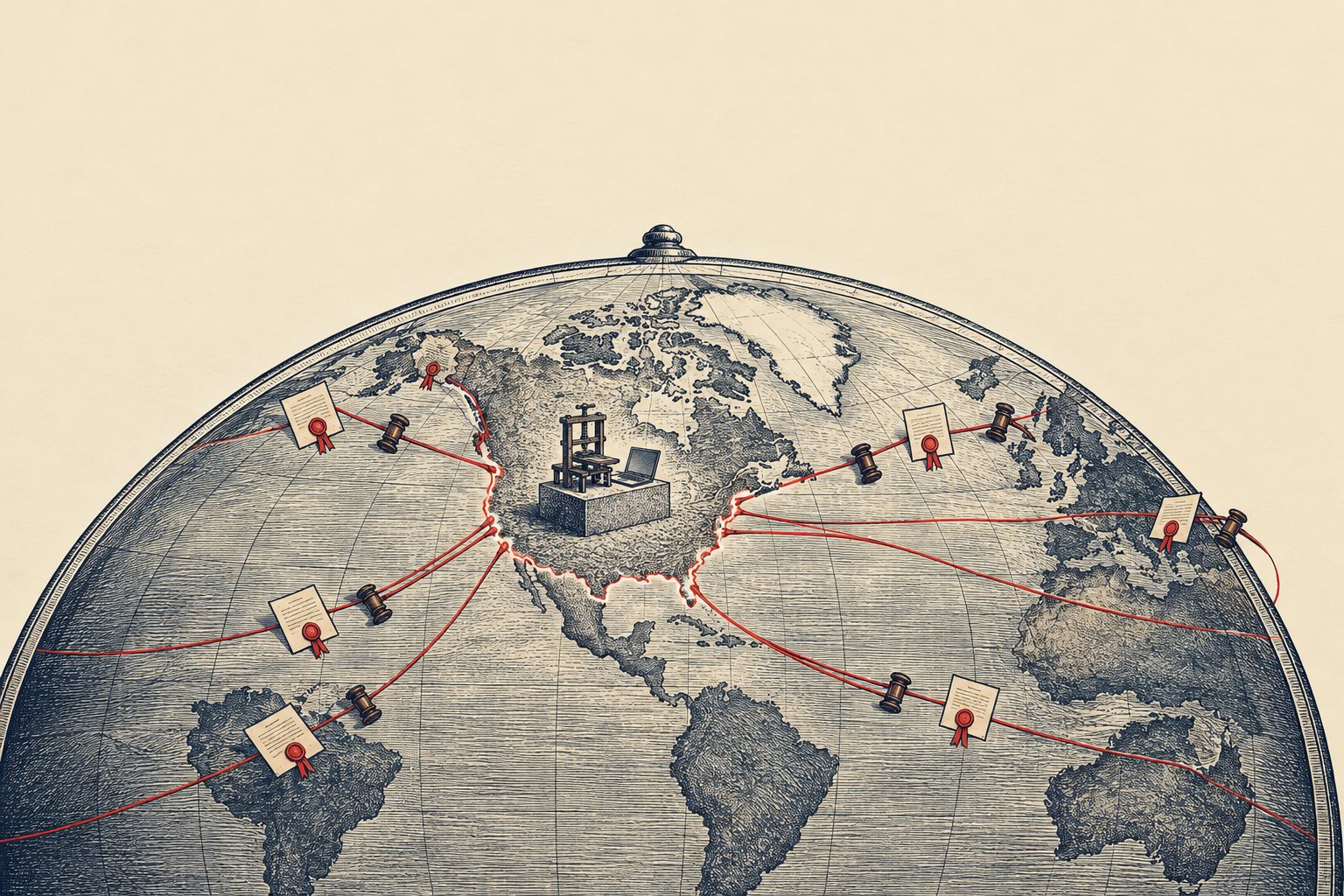
Editorial ink illustration: red threads tied to sealed official documents and gavels stretch across a globe from Europe, Britain, Australia, South America and the Pacific toward North America, where a colonial printing press and a laptop sit on a granite plinth. The threads stop at a bright line around the coast.

Today

Same country, same day.

This morning, Australia’s Royal Commission on Antisemitism and Social Cohesion sent the American lawyer Preston Byrne a direction backed by the threat of jail, after his client, the U.S. platform Gab, published an earlier notice (our feature on Byrne). Hours later, the Australian government introduced a “Digital Duty of Care” bill with penalties of up to A$109.2 million, aimed mostly at American services (Minister Wells; OPAX).

None of this is about the cause the Commission was set up to address. Antisemitism is real and worth fighting. The question is jurisdiction: whether a foreign government can reach into the United States and decide what Americans may publish.


Why this is not just an American fight

The world’s speech runs on American platforms. So the world’s censors aim here.

The First Amendment restrains one government: ours. For two centuries that was enough, because ours was the only government that could reach an American printer. The internet changed that. A post written in Ohio is published in Brussels, London, Sydney, Ottawa and São Paulo at the same moment, and every regulator in those places now claims some power over it.

Regulators don’t need to win in an American court to get their way. They need the platform to comply. When a U.S. company changes its global rules to satisfy one foreign regulator, the change reaches users in Kansas and Kenya alike. Preston Byrne reports that of 197 American targets of the UK’s Online Safety Act program, only four U.S. companies refused (Byrne). “Most censorship happens in secret,” he writes, “hidden away from public view, as intended.”

That makes the First Amendment more than a domestic rule. It is the last legal high-water mark for free expression anywhere. If it can be worn down by foreign leverage on American companies, there is no refuge left for the dissident in Britain, the journalist in Brazil or the researcher in Australia. Defending it is not American exceptionalism. It is how a protection written for one country ends up protecting everyone who publishes through it.

“Censoring Americans in America is a red line.”

Sarah B. Rogers, U.S. Under Secretary of State for Public Diplomacy, on GB News, December 2025 (reported by Sayer Ji)

The fronts

Six jurisdictions, one direction of travel.

European Union · Digital Services Act

On December 5, 2025 the European Commission fined X €120 million, the first penalty ever issued under the DSA (Commission). X has appealed to the EU General Court, and on September 24, 2026 the U.S. Justice Department applied to intervene on X’s side (Reuters). The fine was for transparency rules. The DSA’s reach is wider: fines of up to 6% of global turnover.

United Kingdom · Online Safety Act

Ofcom has fined the American site 4chan a total of £520,000 (our case file). 4chan’s U.S. suit against Ofcom was dismissed on September 14 on foreign sovereign immunity grounds, without reaching the First Amendment question (Byrne & Storm). CCDH’s own website says: “Our campaigning resulted in the UK Online Safety Act” (CCDH).

Australia · eSafety and a Royal Commission

A Royal Commission threatening jail over an American platform’s publication (The Epoch Times), and a new Digital Duty of Care bill that would let the eSafety Commissioner run “sock puppet” accounts under false identities (ABC). A Senate inquiry reports November 20.

Canada · Three bills in five years

The Online Harms Act (C-63) died in January 2025. Its criminal-law half returned as the Combatting Hate Act (C-9), law since June 18, 2026; its platform half returned as the Safe Social Media Act (C-34), with a new Digital Safety Commission and an under-16 ban (LEGISinfo; Michael Geist).

Brazil · A whole platform switched off

In August 2024 Supreme Court Justice Alexandre de Moraes ordered X suspended nationwide after it refused orders to block accounts and closed its Brazilian office, with fines threatened for anyone reaching it by VPN (Reuters). X came back in October 2024 after paying fines and blocking accounts (Reuters Institute).

Russia · It works on Americans too

In September, Russia’s censor Roskomnadzor demanded that the Human Rights Foundation’s Tyranny Tracker be removed. HRF refused. Its Texas web host geo-blocked the site anyway in under 24 hours. Byrne calls it the first publicly known case of Russia censoring Americans in America, and adds: “Russia succeeded” (Byrne).

The democracies and the autocracy use different words: “safety,” “harm,” “disinformation,” “national law.” The mechanism is the same: lean on the American company, and let the company do the censoring.


The playbook, in its own words

“Kill Musk’s Twitter.” “Trigger EU & UK regulatory action.”

In October 2024, Paul D. Thacker and Matt Taibbi published internal planning notes from the Center for Countering Digital Hate, a London-founded group with a Washington office (The DisInformation Chronicle). Under “Annual Priorities,” the notes list four items:

Annual Priorities

  • Kill Musk’s Twitter
  • Advertising focus
  • Trigger EU & UK regulatory action
  • Progress towards change in USA and support for STAR

Transcribed from CCDH’s “Portfolio Planning Monthly Meeting” notes (full document, DocumentCloud).

The same notes record CEO Imran Ahmed at a January 8, 2024 meeting: “RFK — black ops being set up to look at RFK. Nervousness about the impact of him on the election.” Robert F. Kennedy Jr. was then a candidate for president. Elsewhere, staff discuss whether CCDH can “attach our name” to Canada’s Online Safety Bill with “no actual staff in Canada,” and Ahmed says: “Showing a global movement will be powerful.” The House Judiciary Committee cited the notes when it pressed CCDH for documents (letter of Nov. 7, 2024).

Ahmed has said “Kill Musk’s Twitter” was internal “shorthand” (The Spectator). Readers can weigh that. What is not in dispute is what followed. The EU fined X. Speaking to fellow researchers in 2026, Ahmed himself listed the fine as the moment “British and European authorities began using those powers in earnest” (Foundation for Freedom Online). We do not claim the memo caused the fine. We note that the goal was written down first.

That is why Americans CCDH named as the “Disinformation Dozen,” including this coalition’s founder, describe the operation as a foreign influence campaign aimed at Americans. Critics, including America First Legal, have asked the Justice Department to examine whether CCDH’s U.S. arm should register under the Foreign Agents Registration Act (AFL letter). The Department has announced no action, and no court has found a FARA violation. CCDH says it is an independent research nonprofit.


The Trojan horses

It never arrives labeled censorship. It arrives labeled safety.

No government passes a law called the End of Free Speech Act. Britain’s version was sold as online safety. The model travels the same way, in three vehicles: a framework, a child-safety bill and, next, AI regulation.


Editorial ink illustration: a wooden Trojan horse built from children's toy blocks and tied with a red ribbon is rolled through the gate of a colonial town with a print shop. A hatch in its belly is open, showing padlocks, scissors, a gavel and chains inside.

1 STAR: the blueprint

CCDH’s STAR framework (Safety by Design, Transparency, Accountability, Responsibility) came out of a May 2022 CCDH summit that, by Ahmed’s account, convened lawmakers from the U.S., EU, UK, Canada, Australia and New Zealand (CCDH). CCDH calls it “a global standard for regulating social media.” Its 2024 version urges governments to “enshrine duties of care to address online harms” and to “mandate risk assessments and mitigation plans,” and scores countries on how much of it they have adopted (STAR report). “Support for STAR” is the fourth annual priority in the leaked notes.

Ahmed has explained that the letters run in a different order in practice: “They don’t actually go in that order, they go as TARS: transparency is required for accountability; when people are held accountable, you have to make them bear economic responsibility for it; and eventually we think that will lead to safety by design” (Columbia Journalism Review).

None of the four words mentions speech. Each becomes a lever over it. Take “transparency.” CCDH says it “successfully secured two amendments” to the Online Safety Act on researcher access to platform data (CCDH). In the EU, €40 million of X’s €120 million fine was for not giving researchers access to public data (DW). The State Department’s record notes that Ahmed was listed as a signatory to a petition urging the Commission to act on exactly that (Ahmed v. Rubio). Groups like CCDH are the researchers who would use that access.

2 KOSA: the “duty of care” comes to America

The heart of Britain’s Act is a set of legal duties on platforms. The same idea is now in four parliaments: Australia’s Digital Duty of Care bill, introduced today; Canada’s C-34, with platform duties enforced by a new commission; and in Washington, the Kids Online Safety Act. CCDH endorsed KOSA, with Ahmed praising it for making platforms “safe by design” (CCDH). Its August 2026 wish list for Congress puts “Give platforms a legal duty to protect children” first (CCDH).

The Senate bill, S. 1748, has 76 cosponsors and was reported out of Senate Commerce on August 5. The House passed the KIDS Act, a rewritten version without the duty of care but with new chatbot rules, 267–117 in June (our KOSA feature). The Electronic Frontier Foundation warns that under a duty of care, “the safest response is to remove lawful speech or shut down forums discussing those topics altogether” (EFF). That is how a child-safety rule becomes a speech rule. Nobody orders a post removed. The liability makes removal the cheapest choice. (X itself backed a revised KOSA in December 2024. On this, we disagree with X.)

3 AI: the next horse

In November 2024, Ofcom told AI companies that the Online Safety Act already reaches generative AI chatbots, and that AI-generated content shared by users “would be regulated in exactly the same way as human-generated content” (Ofcom). Canada’s C-34 adds a separate AI chatbot regime (Michael Geist). CCDH now describes “safety by design” as “ensuring social media and AI products are safe for the public prior to launch” (CCDH).

On August 12, 2026, CCDH’s UK company changed its legal name to the Center for Countering Digital Harm Ltd (Companies House), as Sayer Ji first reported. Hate is a speech word. Harm is a regulatory word, and it is the operative word of the Online Safety Act.

Why this matters more than any social network: AI is becoming how people search, read, learn and write. A “duty of care” over what an AI may say is a duty of care over the answers a whole society is allowed to get. The risks of AI are real and worth debating. Speech controls dressed up as product safety are not the answer (why AI is a First Amendment fight).

The frameworkSTAR

“Safety by design” becomes censorship by design.

The billKOSA

“Duty of care” makes removal the cheapest choice.

The frontierAI

“Harm” reaches the answers people may get.


Washington’s answer

For the first time, the U.S. government pushed back.

  • May 2025The State Department announces a visa policy against foreign officials and others who censor Americans.
  • Dec 19, 2025Secretary of State Marco Rubio signs a memo to the Department of Homeland Security determining that Ahmed, a British citizen and U.S. permanent resident, is deportable (NPR).
  • Dec 23, 2025Visa bans on five Europeans, including former EU Commissioner Thierry Breton and Ahmed, for “organized efforts to coerce American platforms to censor, demonetize, and suppress American viewpoints” (Reuters).
  • Feb 2026The government’s certified record lists its reasons, including: “Leaked CCDH documents listed ‘kill Musk’s Twitter’ and ‘trigger EU and UK regulatory action’ as priorities” and CCDH’s advocacy for the Online Safety Act and the DSA (quoted in Ahmed v. Rubio).
  • July 2026In a separate case, a federal judge in Washington pauses the visa policy as likely violating the First Amendment (Politico).
  • Sept 8, 2026Judge Loretta Preska dismisses Ahmed’s suit for lack of jurisdiction, not on the merits; review comes later, in the court of appeals (opinion). His protection from detention stays in place while the Second Circuit hears his appeal (Civil Rights Litigation Clearinghouse).

Rubio’s legal ground is the immigration law’s foreign-policy provision, which reaches people whose presence would have “potentially serious adverse foreign policy consequences.” It is not FARA. Ahmed calls the case retaliation for his speech, and the courts have not ruled on that question. We think the conduct in the record, pressuring American companies and recruiting foreign regulators against American speech, is the issue. Either way, the principle being tested is the one this page is about: whether foreign pressure on Americans’ speech has consequences.


The shield

Preston Byrne’s answer: make it unenforceable here.

Visa bans reach individuals. They don’t stop a foreign regulator from fining an American company or threatening its staff. Preston Byrne, a lawyer qualified in both the U.S. and the UK who has represented American targets of the Online Safety Act, drafted the fix: the GRANITE Act. It gives First Amendment-protected conduct a categorical shield from foreign censorship laws, and gives Americans the right to sue the foreign government in an American court (Byrne).

It has moved fast. The Wyoming House passed a version 46–12 in February. ALEC adopted a model policy in July. In Congress it is H.R. 10174 (Rep. Rulli) and S. 5478 (Sen. Mike Lee) (Congress.gov). Byrne’s point about the Russia case is that it is not a partisan bill: “The GRANITE Act is necessary to protect the First Amendment online, and the need for it is urgent.”

Read our feature on Preston Byrne →

Editorial ink illustration: a village of small lit home studios and newsrooms, linked by fine lines into a network, surrounds a monument of a crossed quill and microphone tied with a red ribbon. Across the water, grey bureaucratic towers cast long shadows that stop before reaching the shore.

The Fifth Estate

The stories they most wanted buried were broken by independents, on X.

Look at who told the public about everything on this page. The CCDH notes were published by two independent journalists on Substack. The Twitter Files, which documented government requests to moderate Americans’ speech, were handed by X in December 2022 to independent reporters, including Matt Taibbi, Michael Shellenberger and Bari Weiss (Racket News index). Today’s Australian story was disclosed by Byrne himself, on X, and amplified there by Shellenberger and others.

That is the Fifth Estate: the independent writers, podcasters, researchers and citizen journalists who answer to readers, not to regulators or advertisers. It exists at scale for one reason. A handful of platforms, X above all since Elon Musk bought it, refused to become the enforcement arm of every government that asked. That is why the memo’s first priority was the platform, not any single post. And it is why the fines, the suspensions and the duty-of-care bills keep landing on the same few companies.

We don’t agree with every decision X makes, and nothing here depends on that. What matters is the principle: when a platform holds the line, millions of people on every continent keep the right to read what their own governments would rather they didn’t. Thank you, @elonmusk, and everyone at X who has taken the fines and the heat to keep that door open.

Explore The Fifth Estate →


Runnymede

Not America against the world. Free people against overreach, on both shores.

None of this is a quarrel with the British, European, Australian, Canadian or Brazilian people. Many of the strongest voices against the Online Safety Act are British. The First Amendment itself grew out of English law, from Magna Carta to the trial of William Penn to John Wilkes. The Americans of 1776 did not reject that tradition. They accused the British government of abandoning it, and then wrote it down.

That is the argument of our feature Across the Water, and of the five Runnymede Principles at its end. The second reads: “No regulator or court should reach speech that was lawful where it was spoken, in either direction.” In either direction. We ask nothing of other countries that we would not ask of our own government. Each people is sovereign over its own law. No government should censor across the water what another people’s law protects.

The Runnymede Principles · open for endorsement

Each people is sovereign over its own law.

Organizations in each country sign separately and speak only for themselves. July 28, 2027 marks 70 years since the American Bar Association dedicated its memorial to Magna Carta at Runnymede.

Read and endorse the Principles →

Read

Sayer Ji’s reporting on the global front.

On this site

What we don’t claim. We don’t claim any foreign government directed CCDH, that the memo caused the EU fine, or that any court has found a FARA violation. The Justice Department has not acted on the FARA request. The deportation determination rests on the immigration law’s foreign-policy ground, and Ahmed’s appeal is pending. Preston Byrne is quoted from his public writing; he did not write or review this page, and quoting him does not mean he endorses the coalition. Thanks to X is our own view, not a partnership.