Feature · The Fifth Estate · September 20, 2026

You are
the media.

There used to be four estates: the clergy, the nobility, the commons, and the press. The press was called the Fourth Estate because it was a check on the other three. Then, sometime around the year 2000, a fifth appeared — not a new institution, but a network of ordinary people, publishing without permission, holding the press itself accountable. Its scholar-name is the Fifth Estate. Its plain name is you. This is what it is, why it exists, why it is under sustained attack, and why Restore the First is inviting our coalition members to take it seriously as a pillar of the fight.

What it is · The four eras · Journalists we feature · The Sixth Pillar · You are the media

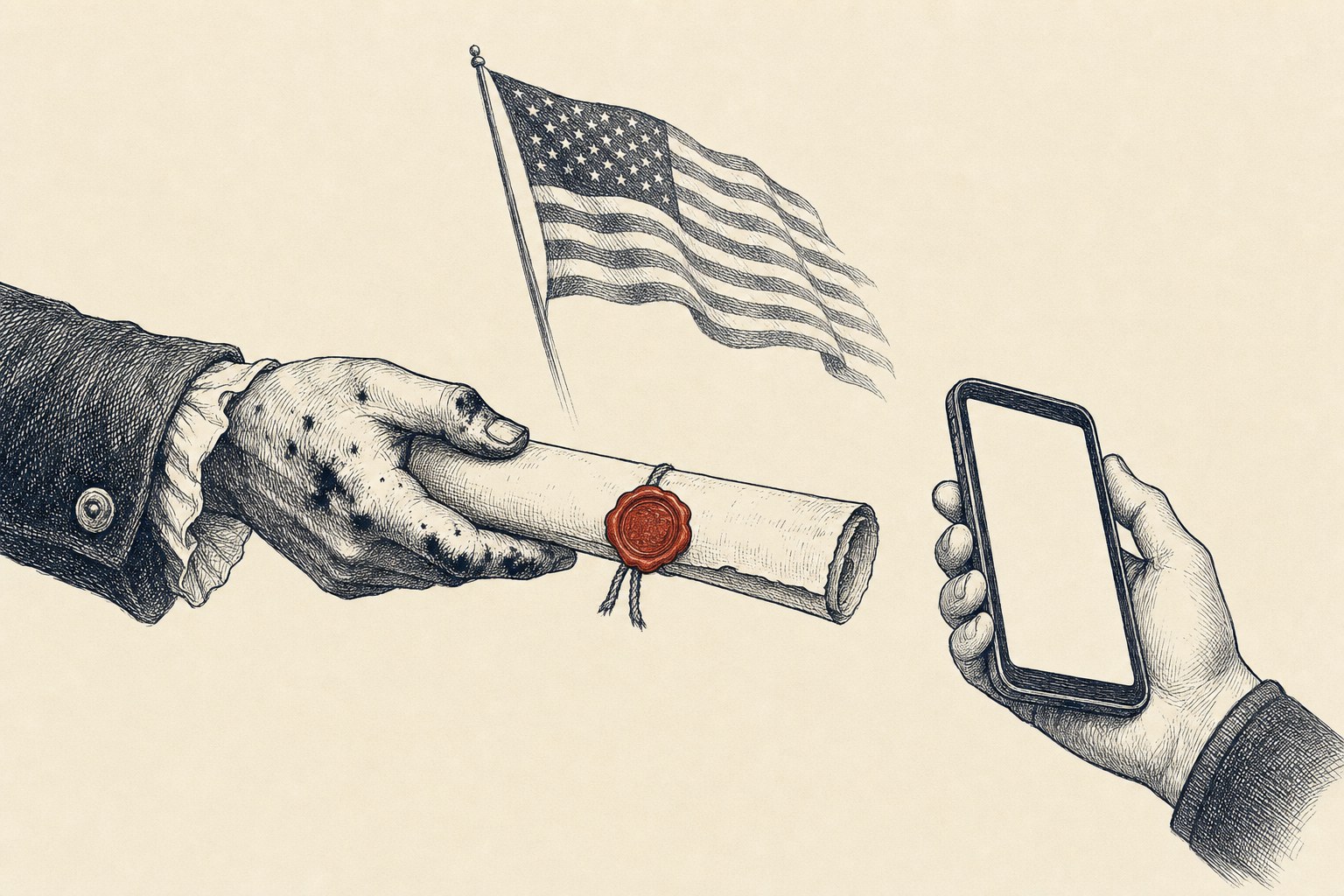
Editorial ink illustration: a colonial pamphleteer's ink-stained hand extending a sealed manuscript to a modern hand holding a smartphone, an American flag furled quietly above.

What the Fifth Estate is, in plain language

The Fourth Estate the traditional press

Newspapers, wire services, network news — the professional press. Edmund Burke is said to have coined the phrase in the House of Commons in the late 1700s, gesturing at the reporters' gallery and calling them a fourth estate more important than the three formal ones. That press is a check on power when it is independent, and a mouthpiece for power when it is not. Both have happened. That is not a partisan claim; it is a description of the last three centuries.

The Fifth Estate Dutton, 2009

In 2009, Oxford sociologist William Dutton defined it clearly: not a blogging community, not an extension of the media, but “networked individuals” enabled by the Internet, especially social media, in ways that can hold the other estates accountable. It includes independent researchers, first-person witnesses, small publishers, doctors and engineers writing under their own names, and the person you follow whose email or feed you actually read. It is defined by direct publication without gatekeeping, not by any political orientation.

The difference who checks whom

The Fourth Estate checks government. The Fifth Estate checks the Fourth Estate — and the corporations, platforms, foundations, and NGOs the Fourth Estate has, in the last quarter century, become co-dependent with. When a Stanford project labels a doctor’s first-person account of a vaccine side effect as “misinformation,” and a wire service repeats that label without checking, the Fifth Estate is what publishes the doctor’s account anyway. It is the accountability layer below the news, not above it.

Every one of these definitions has a source. Dutton’s 2009 article is the canonical scholarly reference; the Nimmo & Combs (1992) and Stephen D. Cooper (2006) uses are earlier. The full timeline sits on the history page.

Why the Fifth Estate exists now · a graphic reading

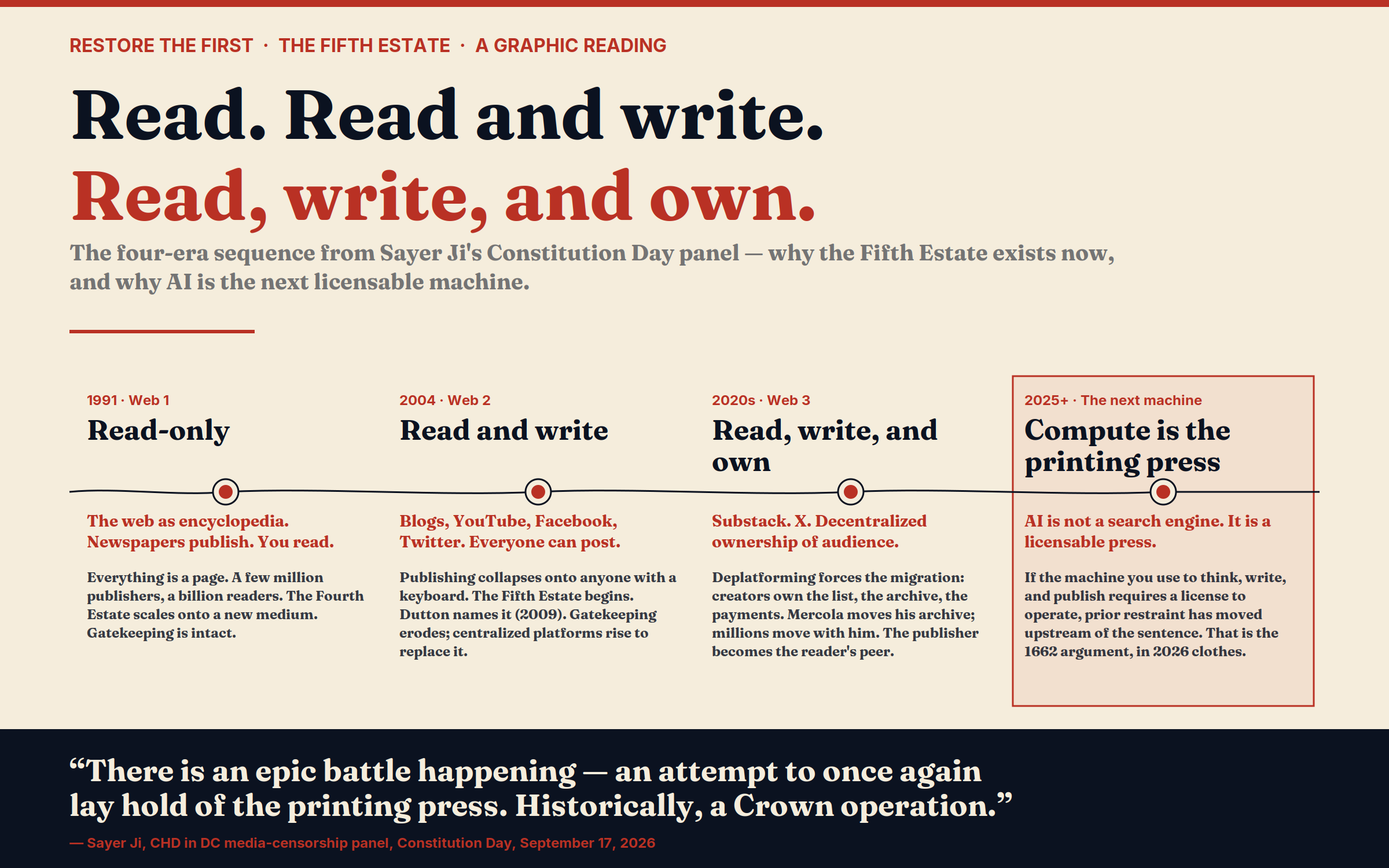
The four eras of the web, and why AI is the next licensable machine.

On Constitution Day, September 17, 2026, Sayer Ji laid out on the CHD in DC media-censorship panel the sequence that answers the question: why now? The web moved through four eras, and each one moved publishing further downstream from the gatekeepers. The Fifth Estate exists because Web 2 made it possible to publish without permission — and it is under siege because Web 3 made it possible to own that publishing, and because the machine that produces the next era of publishing (AI) is now being drafted for a license.

Graphic: four vertical columns labeled 1991 Web 1 Read-only, 2004 Web 2 Read and write, 2020s Web 3 Read write and own, and 2025+ The next machine Compute is the printing press, connected by a red thread. Below, a pull quote from Sayer Ji reads: There is an epic battle happening, an attempt to once again lay hold of the printing press. Historically, a Crown operation.
The four-era sequence, in one image. Read it left to right. The red thread does not stop at Web 3 — it runs into the next machine, where the fight has already moved.

The claim, in one sentence. The 1662 Licensing of the Press Act licensed the machine because prosecuting the sentence had failed. The Kill-Musk directive, the UK Online Safety Act, the EU DSA, and every proposal to license or evaluate AI providers are proposals to license the machine because prosecuting the sentence is failing again. Same instrument, new hardware. The Fifth Estate’s existence is what makes that fight winnable.

The Sixth Pillar of our work.

Restore the First’s policy blueprint names five pillars: the case, the coalition, the legislation, the state private-rights-of-action, and the secure whistleblower intake. Effective today, “You are the media” is the sixth — and it is not an add-on. It is what the other five are for. There is no point in restoring the First Amendment if the citizens it protects have no means of publishing what they know. There is no point in a whistleblower intake if the whistleblower has nowhere to send the story next. There is no point in a policy blueprint if only credentialed press is trusted to describe it.

What the pillar is

A frame, a badge, and a listing — not a subscription.

  • A public commitment to a small set of principles: first-person, verify, cite, correct, protect sources.
  • A small red wax-seal SVG badge you can use anywhere — on your Substack, your site, your X profile, your email signature.
  • An opt-in, moderated listing on the featured section, so readers can find you.
  • Priority access to our secure end-to-end-encrypted intake when you have a source who needs one.
  • An invitation to the coalition’s off-the-record briefings on ongoing litigation and legislation you may want to cover.

What the pillar is not

Not a credential, not a filter, not a payroll.

  • Not an editorial endorsement. We do not vouch for any specific claim any member has made or will make.
  • Not a paywall or a subscription. Free to join, free to leave, no data collection beyond your public listing.
  • Not exclusive. Being on the featured directory does not mean we agree with you on every question, or you with us.
  • Not editable by us. Members write and correct their own listings; if a listing violates the pledge, we remove it publicly and cite why.
  • Not funded by anyone we would not name to the room. Our own funding disclosure is on /about.

The pillar is added to the blueprint at /blueprint#you-are-the-media, alongside the other six programs the coalition operates.

What this section does not claim

Not editorial endorsement of every claim. Restore the First features these thirteen writers because their method is first-person, verified, cited, and correctable — the Fifth Estate’s working definition. We do not vouch for every claim any of them has made, and we do not claim they vouch for every claim we have made.

Not exhaustive. Thirteen is a starting list, not a canon. If you know a Fifth Estate writer we should feature, the featured directory takes nominations at the bottom of that page.

Not anti-institution. The Fourth Estate at its best is essential; the argument here is that the Fifth Estate is what keeps the Fourth Estate honest, not what replaces it. Institutions get better when their critics can publish without asking permission.

Descriptive of the featured writers, at the moment of publication. Where we describe what a writer publishes, what platform they use, or what happened to them, we are describing the record as of September 20, 2026. Where a fact has a specific source, we cite it inline or on the history page.