BreakingRep. Thomas Massie becomes the first cosponsor of the GRANITE Act, the federal bill to stop foreign governments from censoring Americans. Now Congress needs to hear from you. Tell Congress you support it →Read the story →
Coalition call to action · Medical Freedom Act Coalition · October 22, 2026
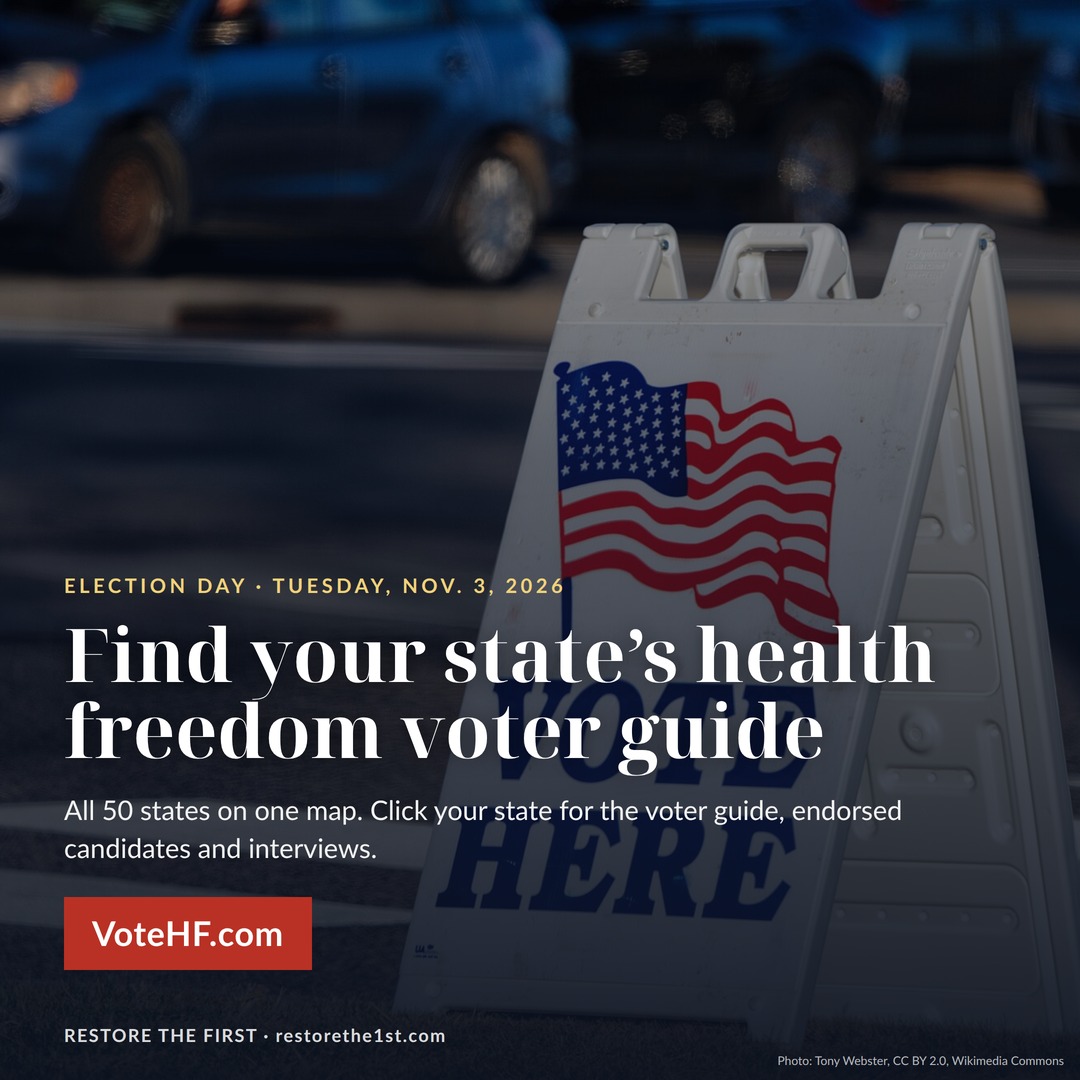
Find your state’s health freedom voter guide.
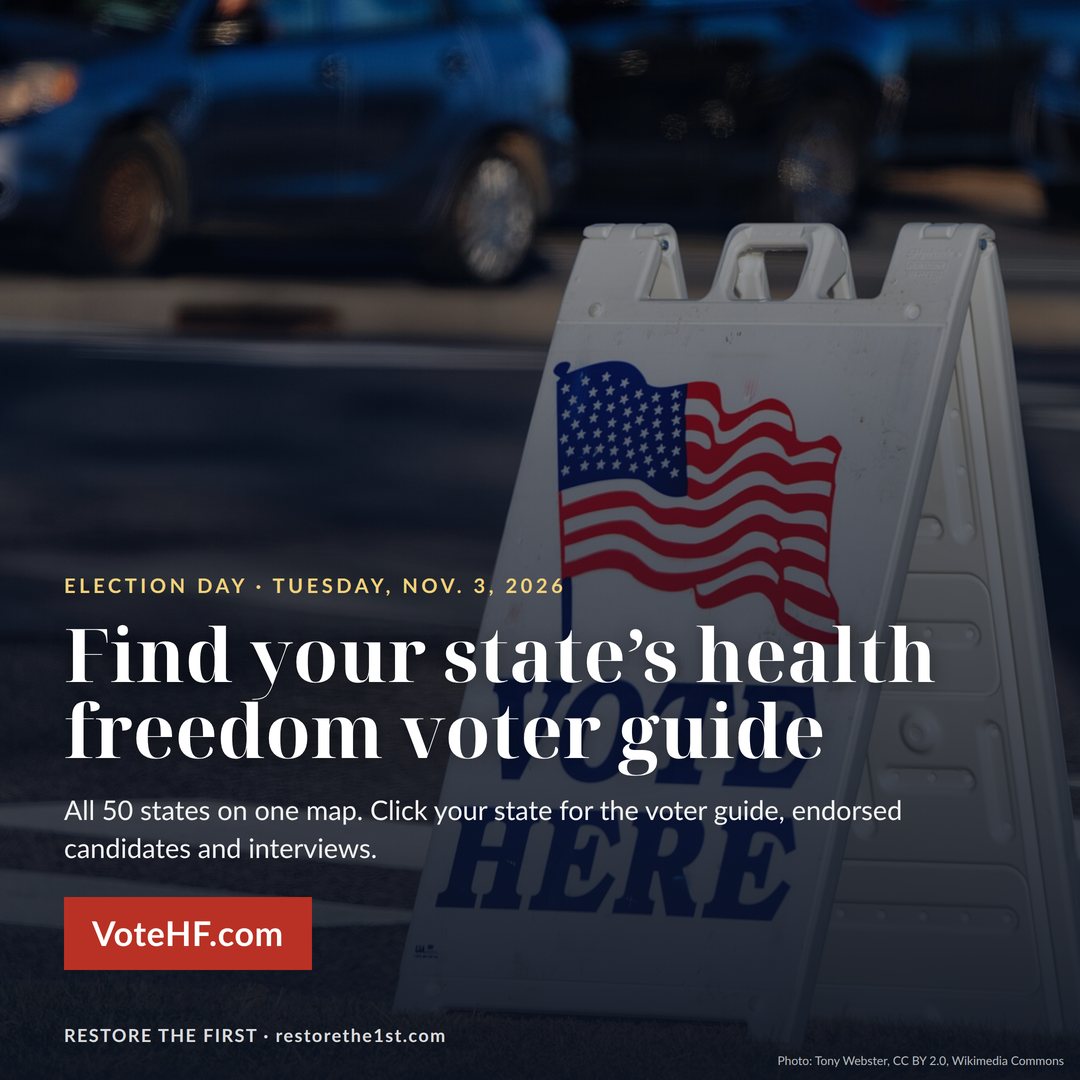
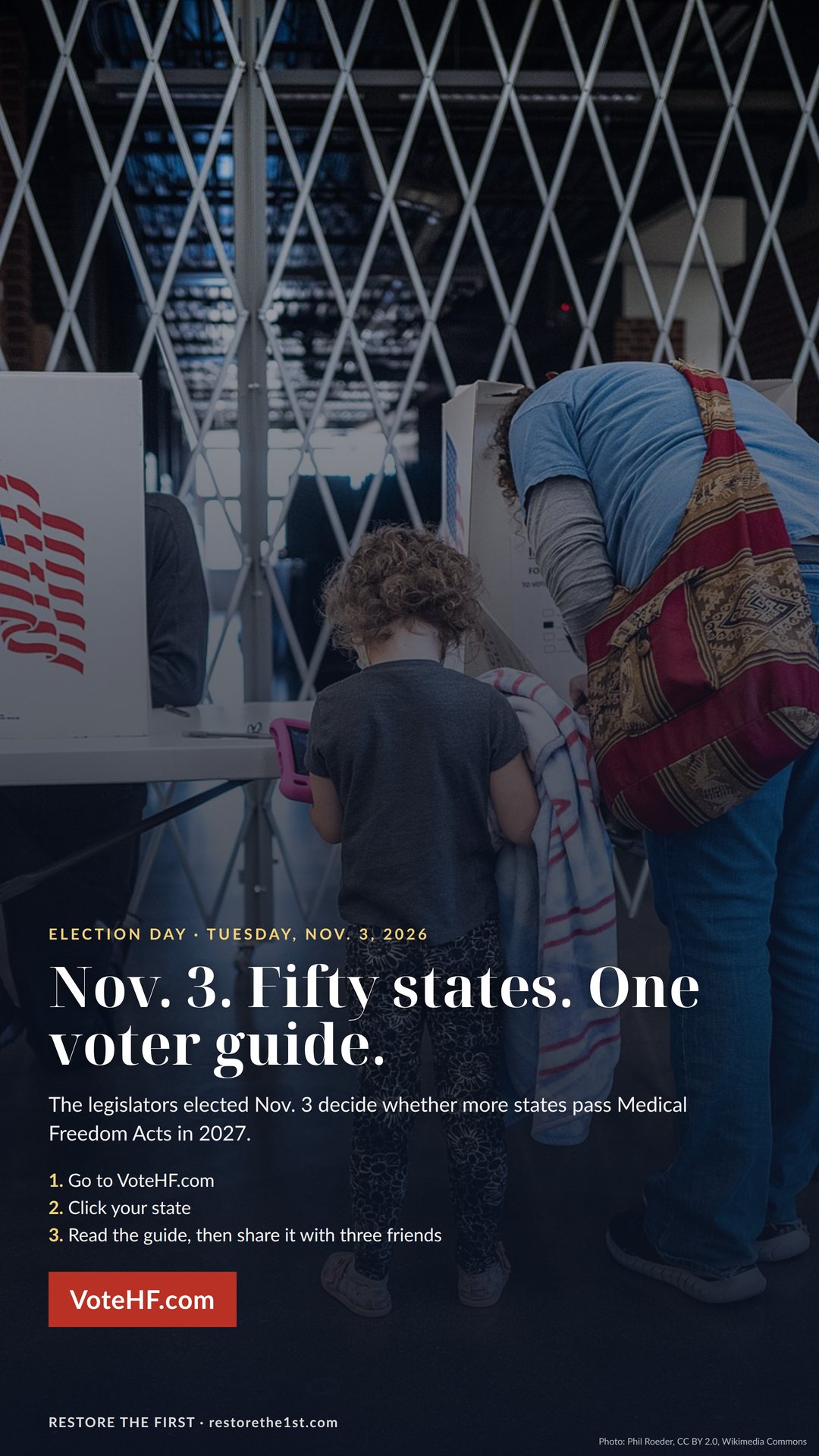
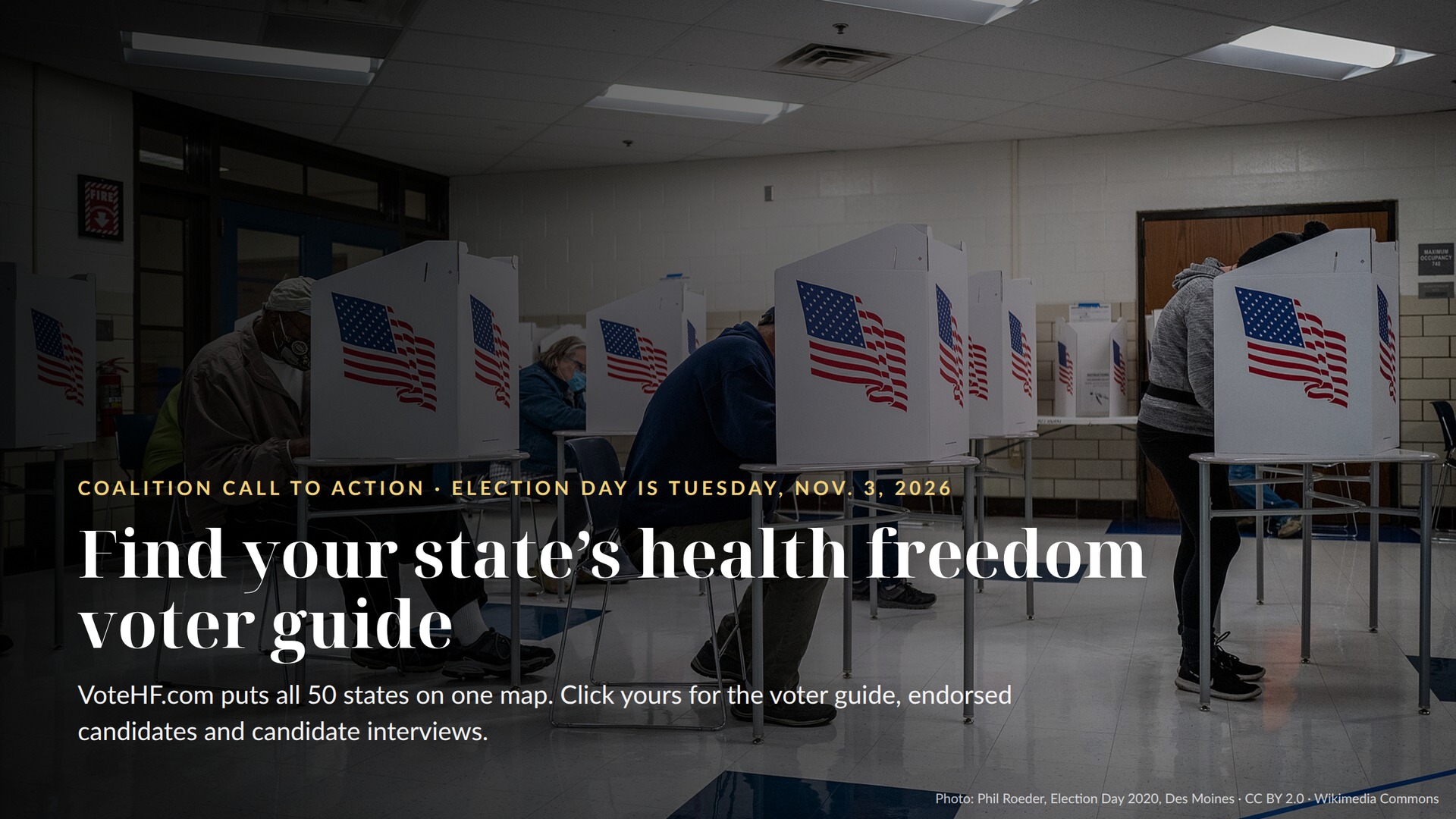
Election Day is Tuesday, November 3, 2026. Stand for Health Freedom has published a 50-state voter guide at VoteHF.com: click your state on the map and you get the voter guide, the endorsed candidates and candidate interviews, for free. The fifteen-organization Medical Freedom Act Coalition has asked every member to put that link in front of its readers before the polls close. This is ours.
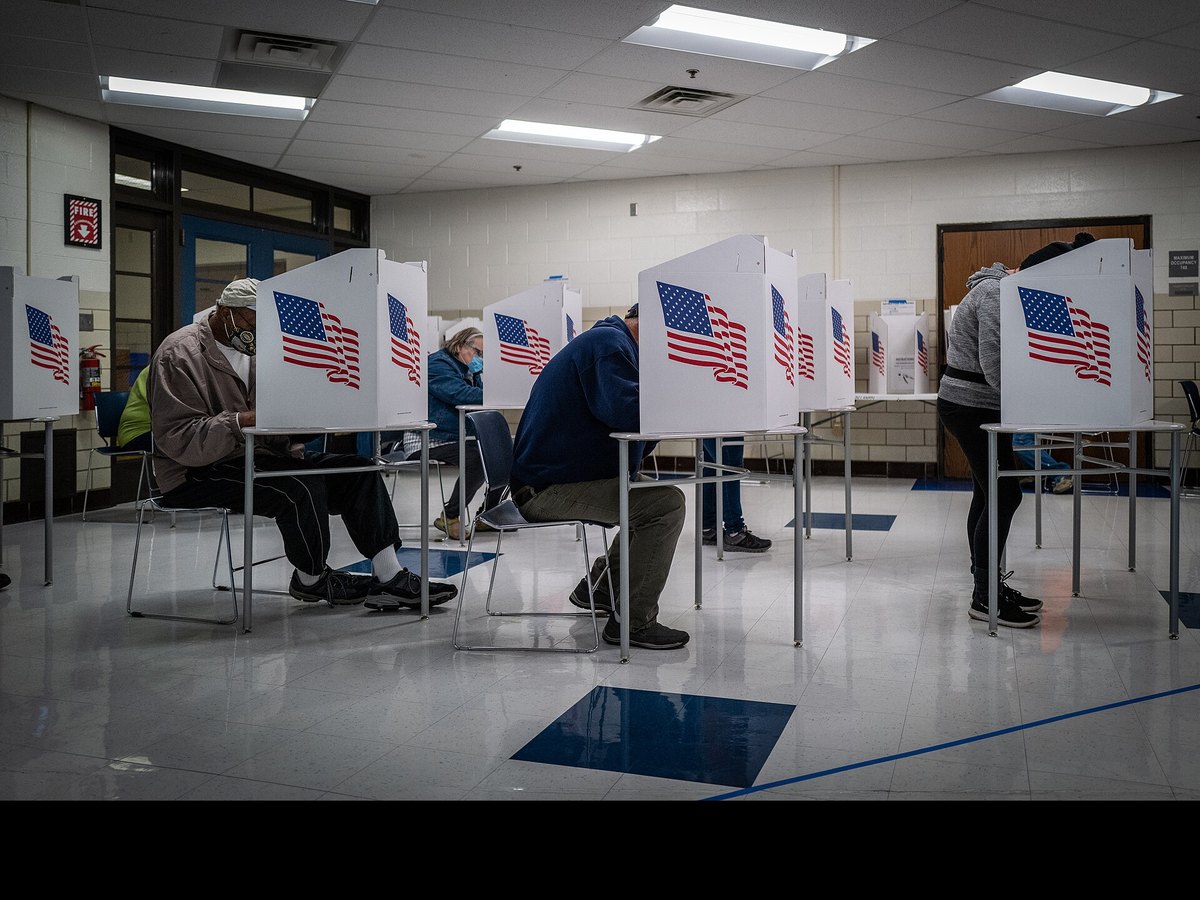
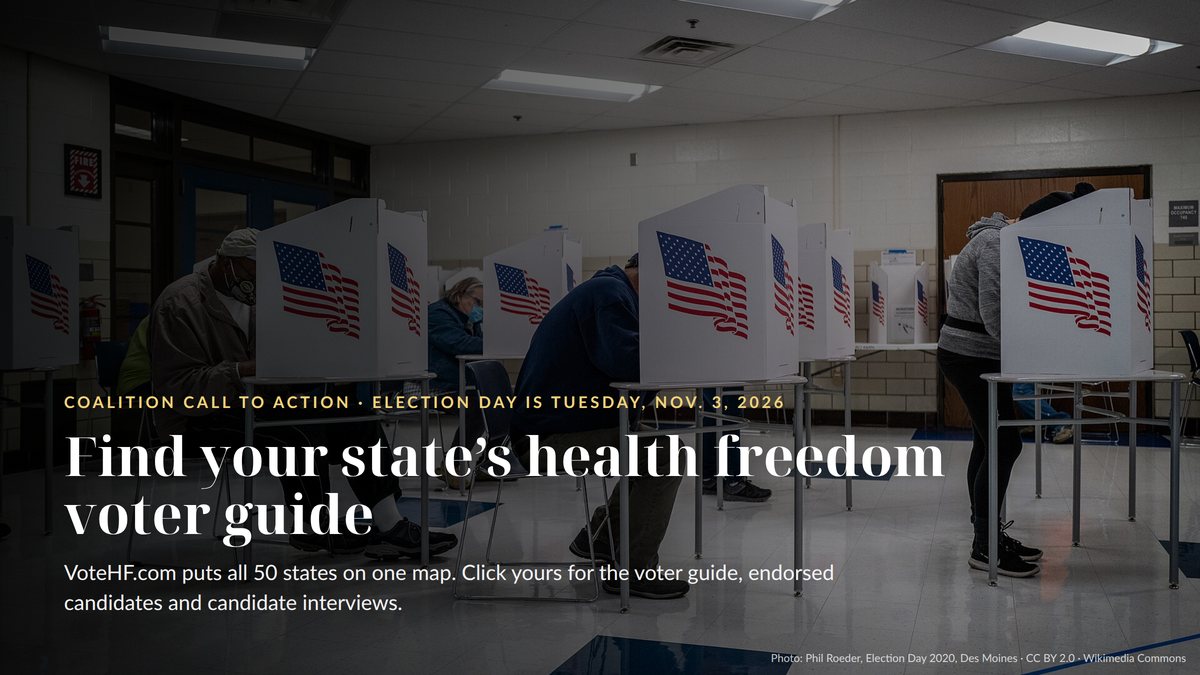
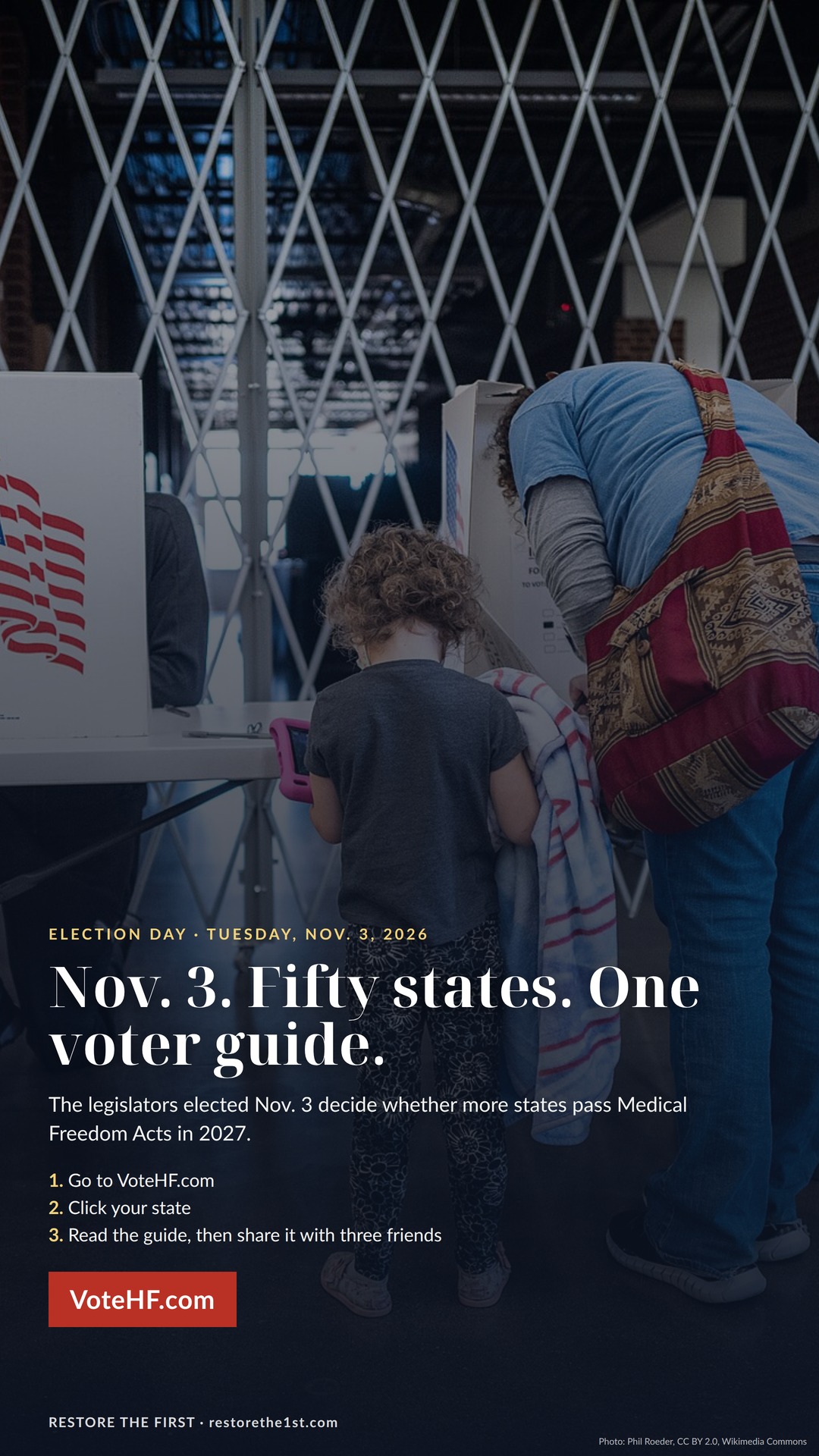
Election Day 2020, Des Moines. Photo: Phil Roeder, CC BY 2.0, via Wikimedia Commons.
Why statehouses · the Medical Freedom Act
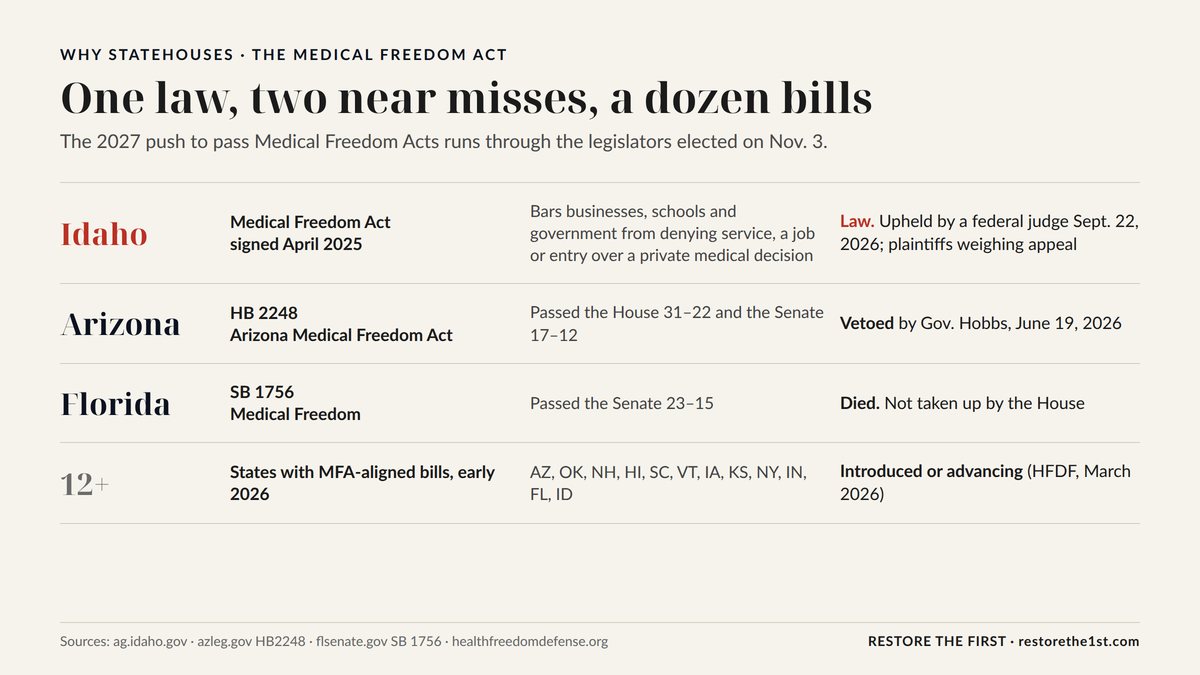
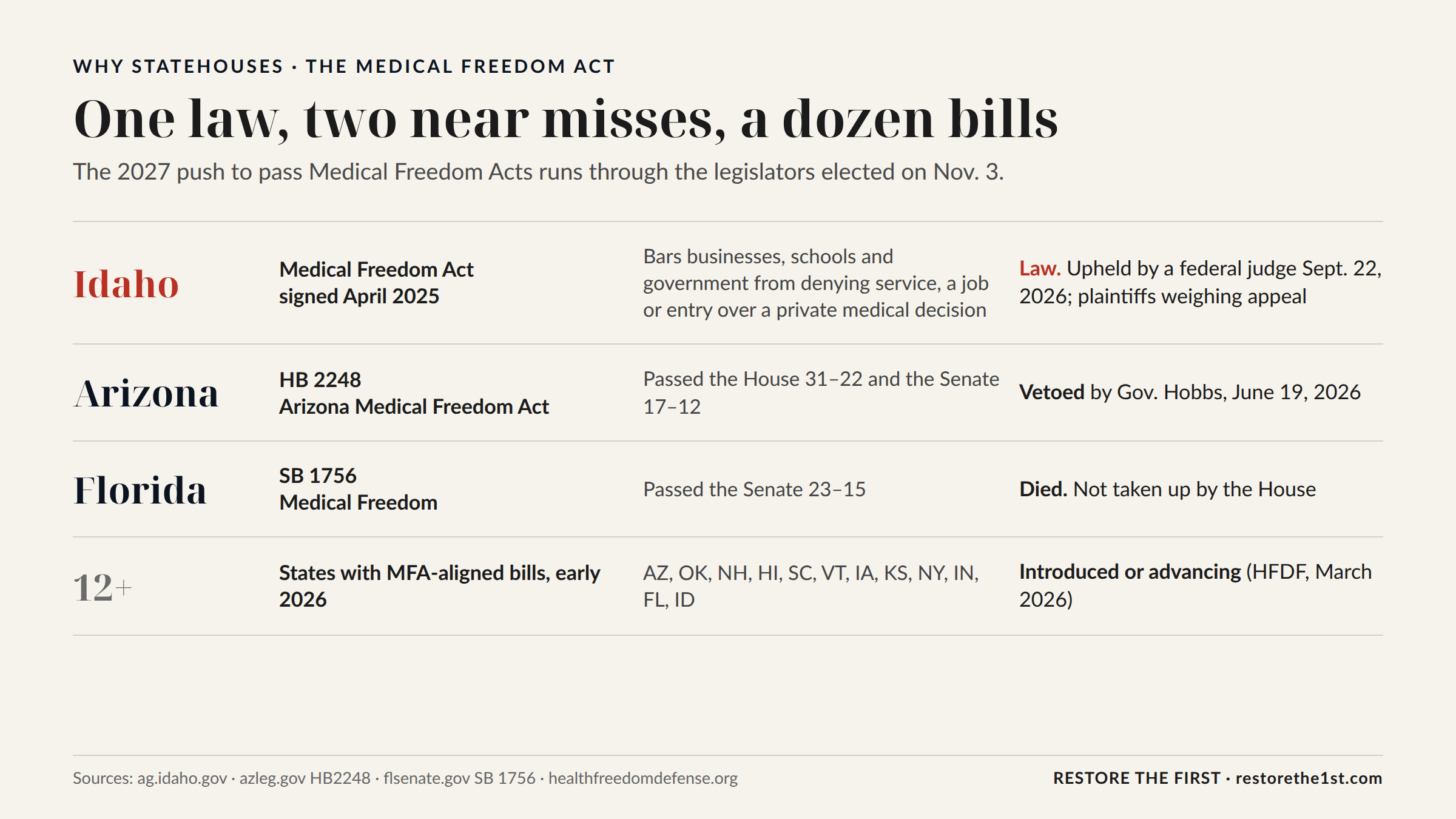
One state law on the books. Two near misses. The difference was who held office.
The reason this is a state story and not a Washington story is a single law in Idaho, and two bills that passed everywhere except the governor’s desk or the second chamber.
Idaho · law
Signed April 2025. Upheld in federal court September 22, 2026.
Passed the House 31–22 and the Senate 17–12. Vetoed June 19, 2026.
HB 2248, the Arizona Medical Freedom Act, cleared both chambers with the same core language as Idaho’s law. Governor Katie Hobbs vetoed it in an 88-bill veto sweep, writing that Arizona already has “robust exemptions” (AZ Free News).
Florida · died
Passed the Senate 23–15 on March 9, 2026. Died in the House four days later.
Where the Medical Freedom Act stands going into the midterms. The 2027 sessions will be decided by the legislators elected on November 3.
The margins · why your ballot
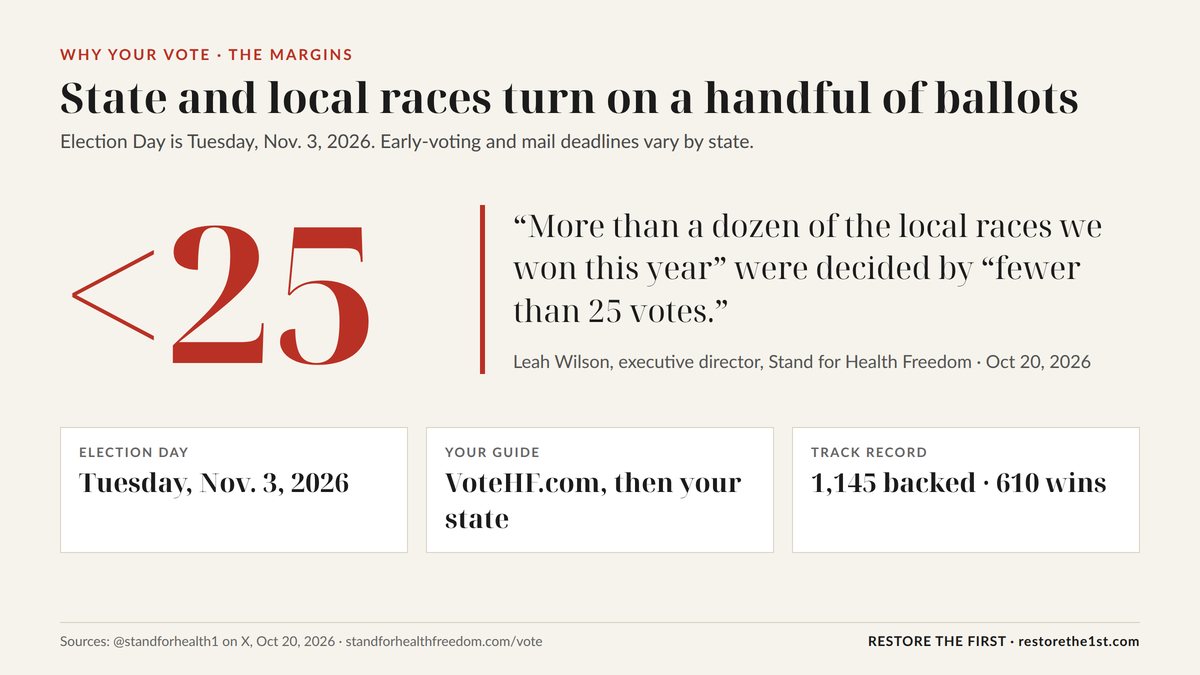
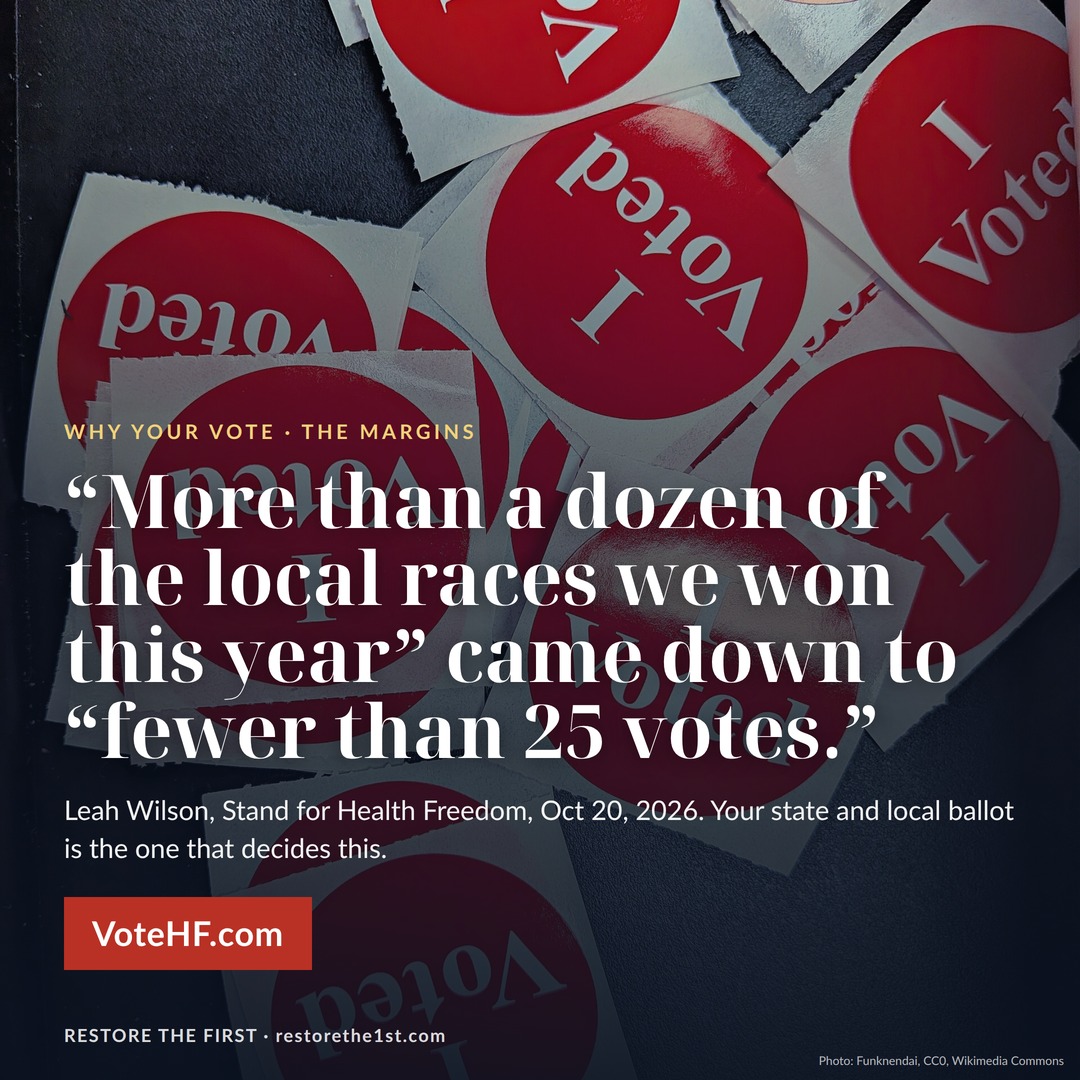
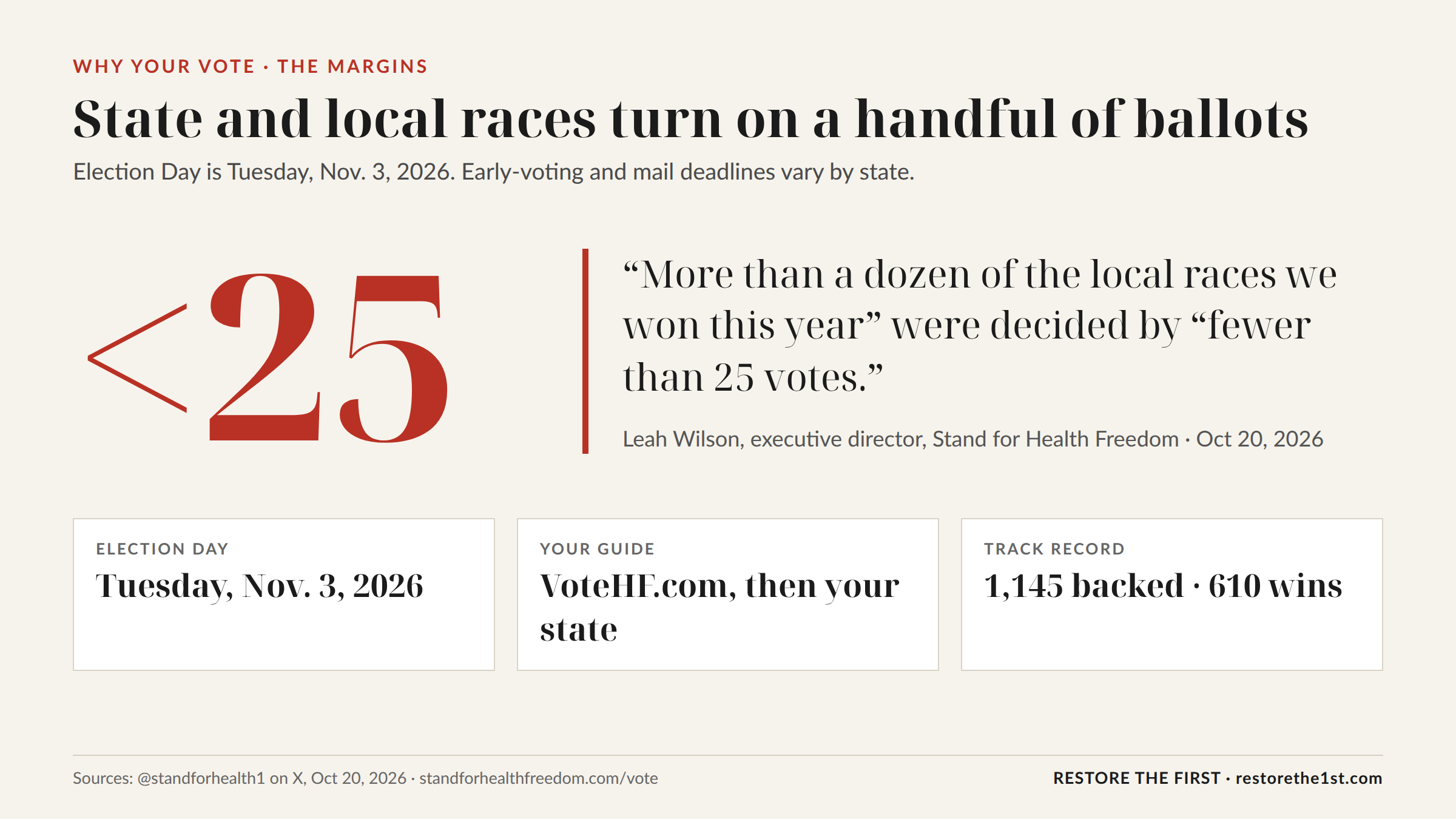
“Fewer than 25 votes.”
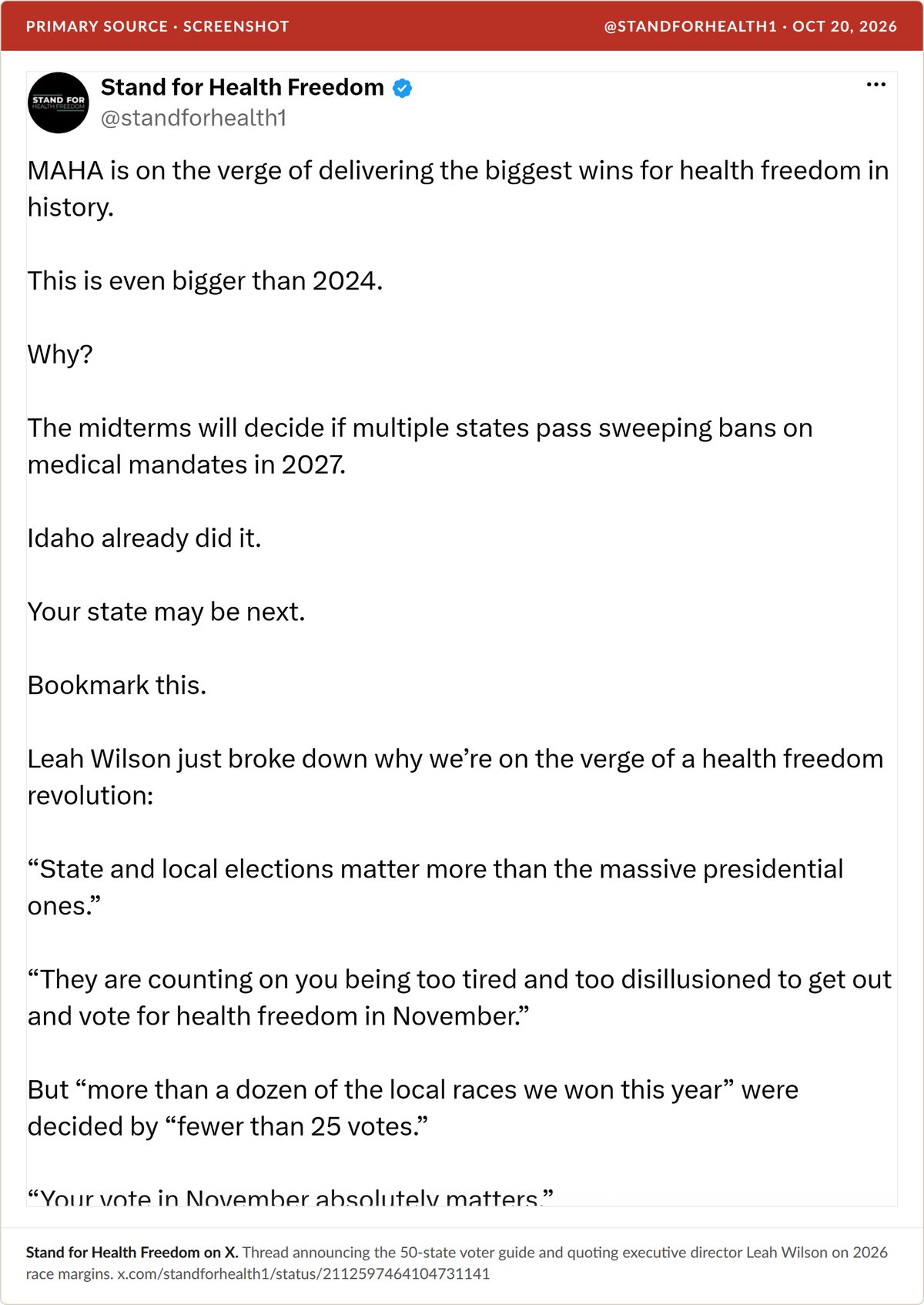
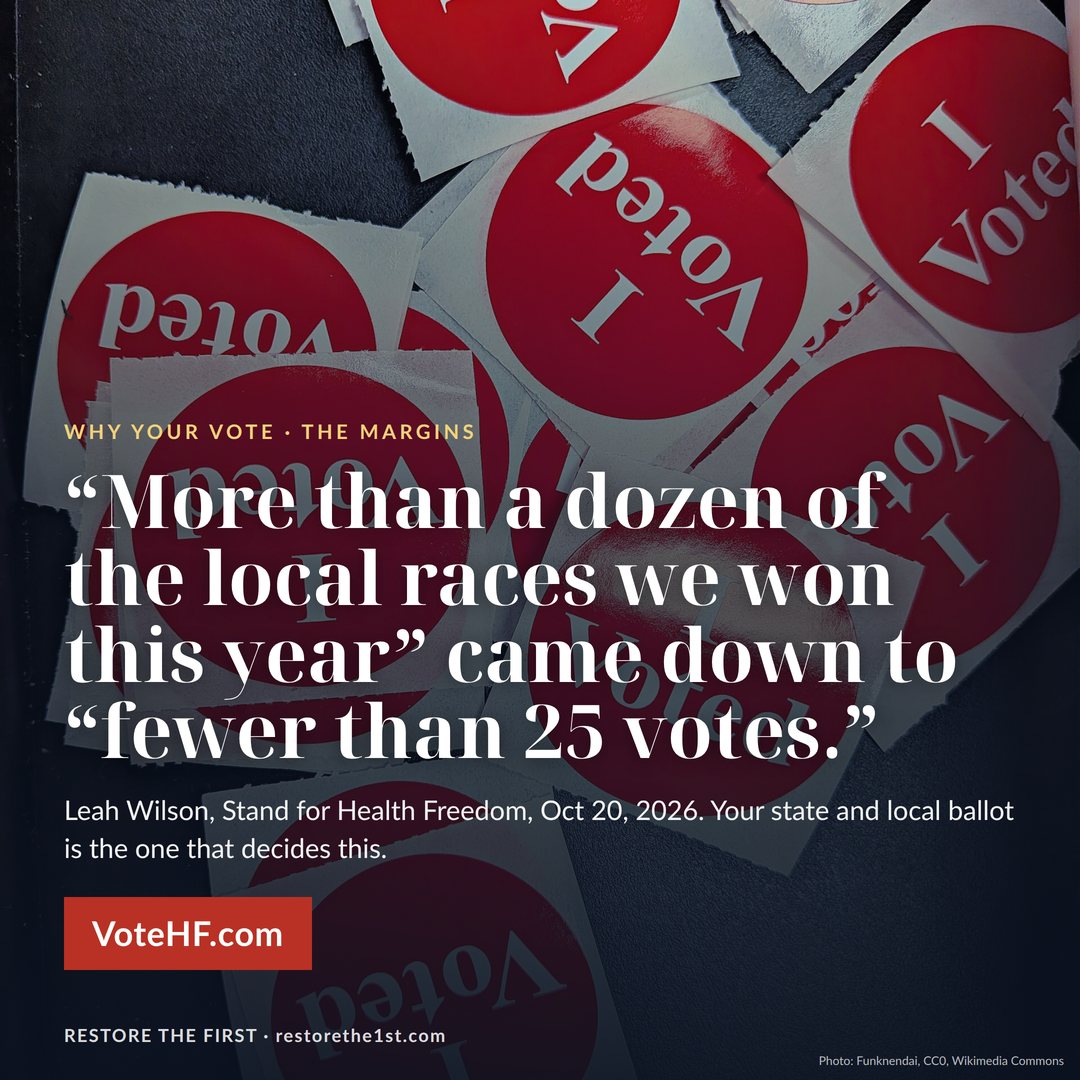
Stand for Health Freedom’s executive director Leah Wilson put the stakes plainly this week: “more than a dozen of the local races we won this year” were decided by “fewer than 25 votes,” according to the group’s October 20 post. That is the scale at which a school board seat, a county commission or a state house district changes hands. It is also the scale at which one reader forwarding one link to three friends is not a figure of speech.
Source: @standforhealth1 on X, October 20, 2026.Primary source: the SHF post, captured October 22, 2026.
What you get · VoteHF.com
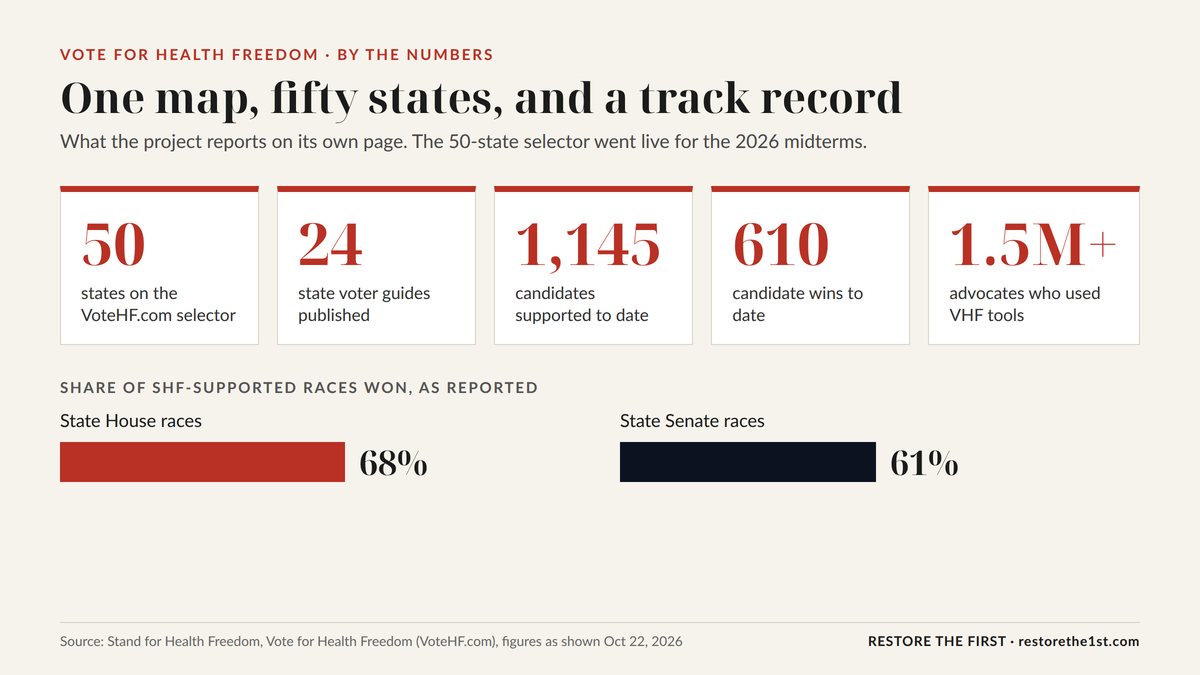
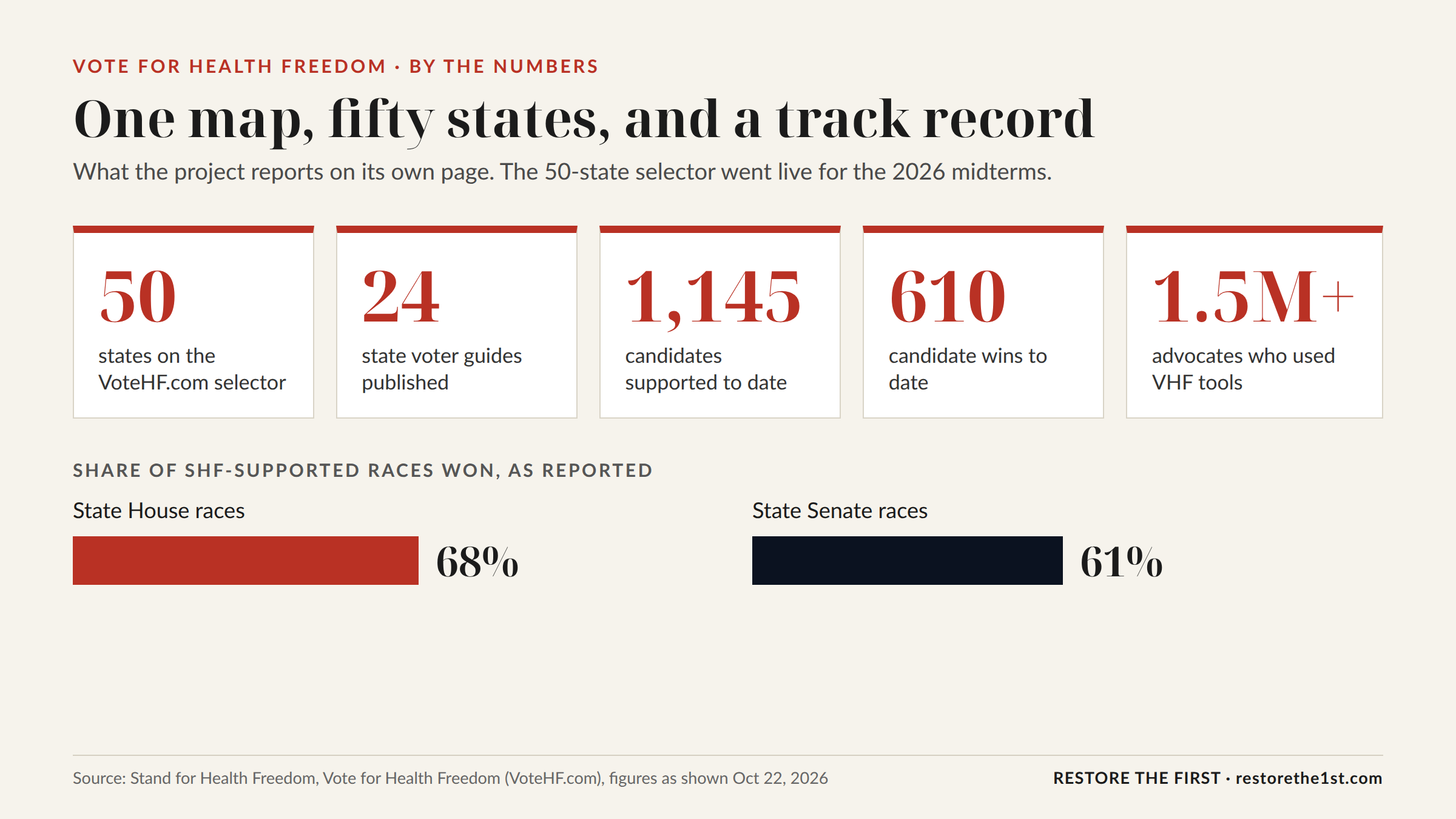
One map, fifty states, and a track record.
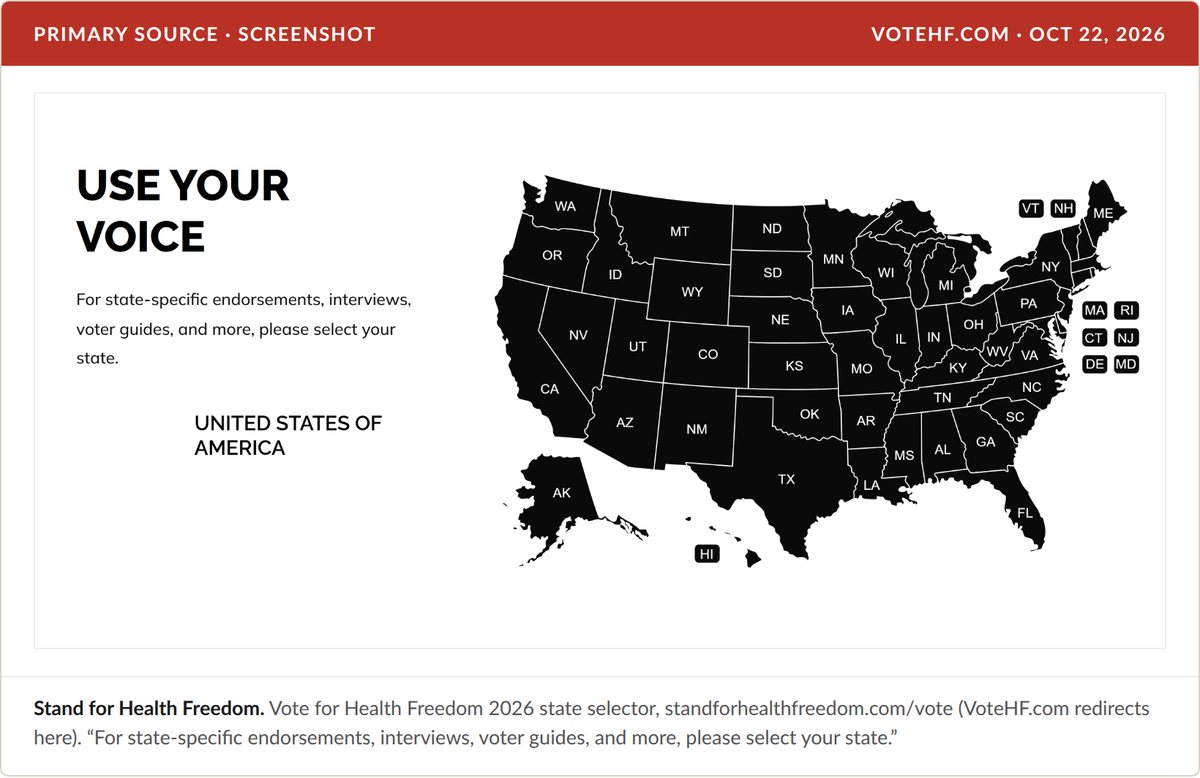
VoteHF.com forwards to the project’s page at standforhealthfreedom.com/vote. The page asks you to pick your state; everything below is drawn from what appears there on October 22, 2026, and it changes as races conclude.
The state selector as it appeared on October 22, 2026.Figures as reported on standforhealthfreedom.com/vote.
01 · The guide
State voter guide
Click your state. The guide lists the races SHF has reviewed and the candidates it has endorsed, from statewide offices down to school boards and sheriffs where it has coverage.
02 · The interviews
Hear the candidate first
State guides pair endorsements with a recorded interview or written questionnaire so you can hear what the candidate has said and done on informed consent and medical coercion, in their own words.
03 · The record
Numbers the project reports
24 state voter guides, 1,145 candidates supported, 610 candidate wins and more than 1.5 million advocates who have used the tools, with 68 percent of supported state house races and 61 percent of state senate races won (standforhealthfreedom.com/vote).
The right to decide and the right to speak about deciding are one right.
Restore the First exists to defend speech infrastructure: the right to publish, to be heard and to think with the tools of the century without a government hand on the platform. The speech that was squeezed hardest between 2020 and 2022 was speech about medical decisions, and the people squeezed were often the same people now building voter guides. SHF’s advocacy director Jill Hines was a plaintiff in Missouri v. Biden, the federal jawboning case we described in our September feature on Vote for Health Freedom as the connective tissue between the two coalitions.
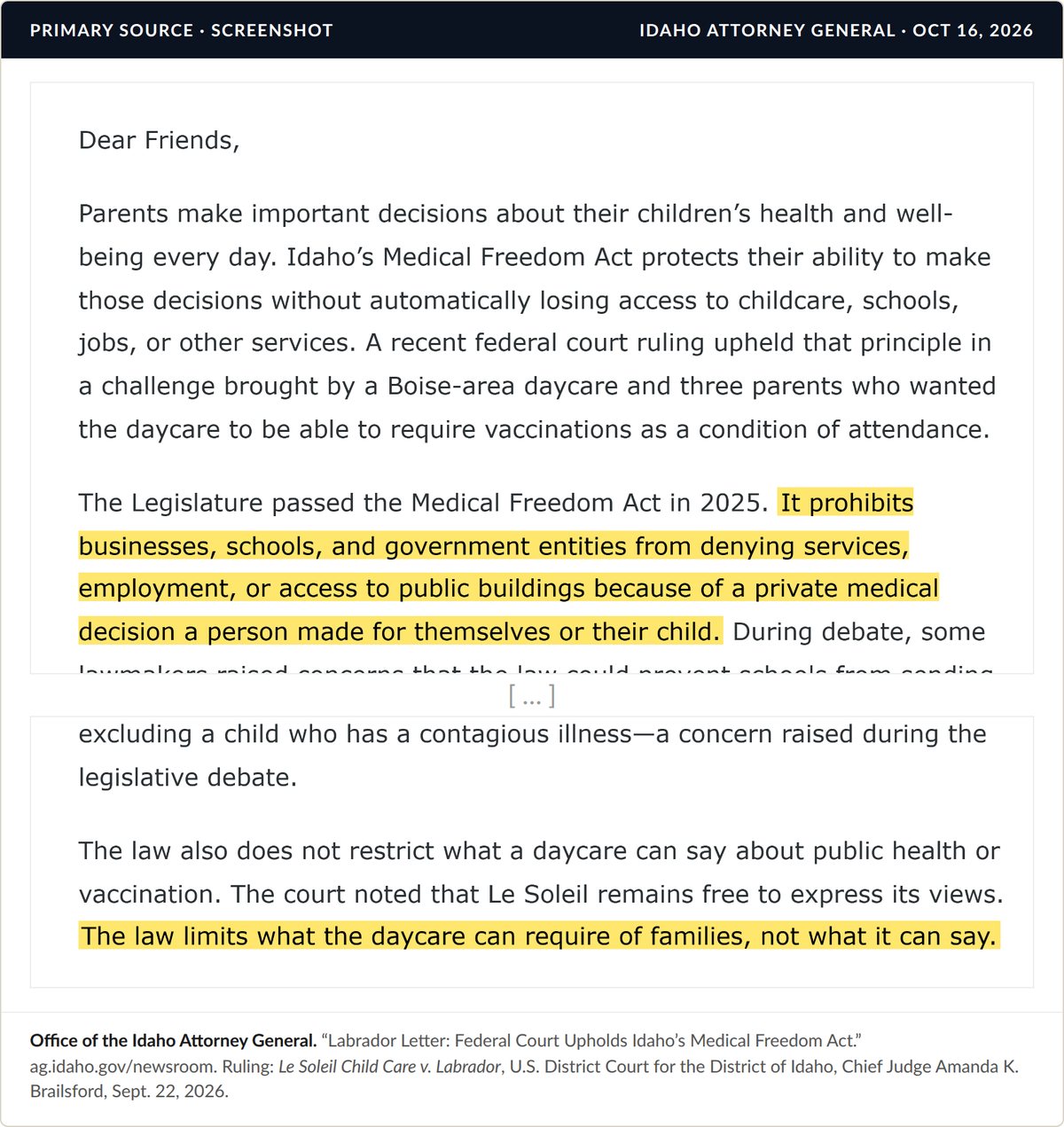
A legislature that protects the first right tends to protect the second. The Idaho case made the point in reverse: the court noted that the daycare “remains free to express its views,” and the Attorney General summarized the ruling in one sentence, that the law “limits what the daycare can require of families, not what it can say.” That is the line we spend our days defending, drawn in a health-freedom case.
What this page is not. Restore the First does not endorse candidates, does not operate a voter guide and takes no institutional position on any specific medical intervention, mandate or exemption regime. The endorsements and guides at VoteHF.com are Stand for Health Freedom’s editorial decisions. We are featuring the project because the underlying rights framework is the same, and because the coalition asked.
Primary source: Office of the Idaho Attorney General, “Labrador Letter: Federal Court Upholds Idaho’s Medical Freedom Act,” October 16, 2026, with the operative sentences highlighted.
Share kit · graphics and posts for amplification
Send it to three people who vote.
Everything below is free to reuse. Each graphic has a download link; each post has a copy button. The photographs are Creative Commons and credited on the image. Nothing here endorses a candidate; every post points to the research at VoteHF.com.
Each post is under 280 characters. Pair it with the graphic named in the label, or post the text alone.
Post 1 · the ask · pair with the landscape or square graphic
Election Day is Nov. 3. Health freedom now has a 50-state voter guide, and it is free.

Go to VoteHF.com, click your state, and you get the voter guide, the endorsed candidates and candidate interviews.

Send it to three people who vote.
Post 2 · why statehouses · pair with the ledger chart
Idaho passed the first Medical Freedom Act in 2025: no business, school or agency may deny you service, a job or entry over a private medical decision. A federal judge upheld it Sept. 22.

Arizona passed the same bill. The governor vetoed it. Statehouses decide this. VoteHF.com
Post 3 · the margins · pair with the margins chart or square
"More than a dozen of the local races we won this year" were decided by "fewer than 25 votes." Leah Wilson, Stand for Health Freedom, Oct. 20.

Your state and local ballot is the one that decides this. Find your guide: VoteHF.com
Post 4 · the record · pair with the numbers chart
Vote for Health Freedom, by its own numbers: 1,145 candidates supported, 610 wins, 24 state voter guides, 1.5M+ advocates reached. For 2026 the map covers all 50 states.

Click yours: VoteHF.com
Post 5 · the First Amendment frame · text only or landscape graphic
We don't endorse candidates. We point you to the research.

The right to decide what goes into your body and the right to speak about that decision are one right, and both were squeezed in 2020-22. Vote like it.

VoteHF.com, then your state. restorethe1st.com/vote-for-health-freedom/voter-guide/
Newsletter or email blurb · the coalition’s suggested language
Find your state's voter guide by going to VoteHF.com and clicking your state on the map. There you can see the voter guide, endorsed candidates, interviews, and more. Election Day is Tuesday, November 3. Please share this with anyone in your state who votes.
Repost the originals
Stand for Health Freedom’s own posts carry the voter guide announcement. Reposting them is the fastest way to help.
You do not have to endorse anyone. Point to the research.
The Medical Freedom Act Coalition’s ask to its members is narrow by design: share the VoteHF.com link with your list, share SHF’s own posts, and encourage your readers to vote with health freedom in mind. No member organization needs to make an endorsement of its own or put a nonprofit status at risk; SHF has done the candidate vetting and publishes the guides under its own name. Restore the First is following the same rule on this page.
Not an endorsement of any candidate. Restore the First does not endorse candidates, does not operate a voter guide, and takes no position on any specific race. This page carries a coalition partner’s call to action; the endorsements, guides and voter tools at VoteHF.com and standforhealthfreedom.com/vote are Stand for Health Freedom’s editorial decisions, not ours.
Descriptive of SHF, at the moment of publication. Figures quoted from standforhealthfreedom.com/vote (24 state voter guides, 1,145 candidates supported, 610 candidate wins, 1.5 million advocates, 68 and 61 percent win rates) are as shown on October 22, 2026 and change as races conclude. Legislative facts are drawn from the Idaho Attorney General, the court’s order in Le Soleil Child Care LLC v. Labrador, the Arizona Legislature, the Arizona Governor’s office, the Florida Senate and Health Freedom Defense Fund.
Photographs. Phil Roeder (Election Day 2020, Des Moines; CC BY 2.0), Tony Webster (Vote Here sign; CC BY 2.0), Funknendai (I Voted stickers; CC0), Tamanoeconomico (Idaho State Capitol; CC BY-SA 4.0), all via Wikimedia Commons. Screenshots of votehf.com, ag.idaho.gov and x.com captured October 22, 2026 for documentation.