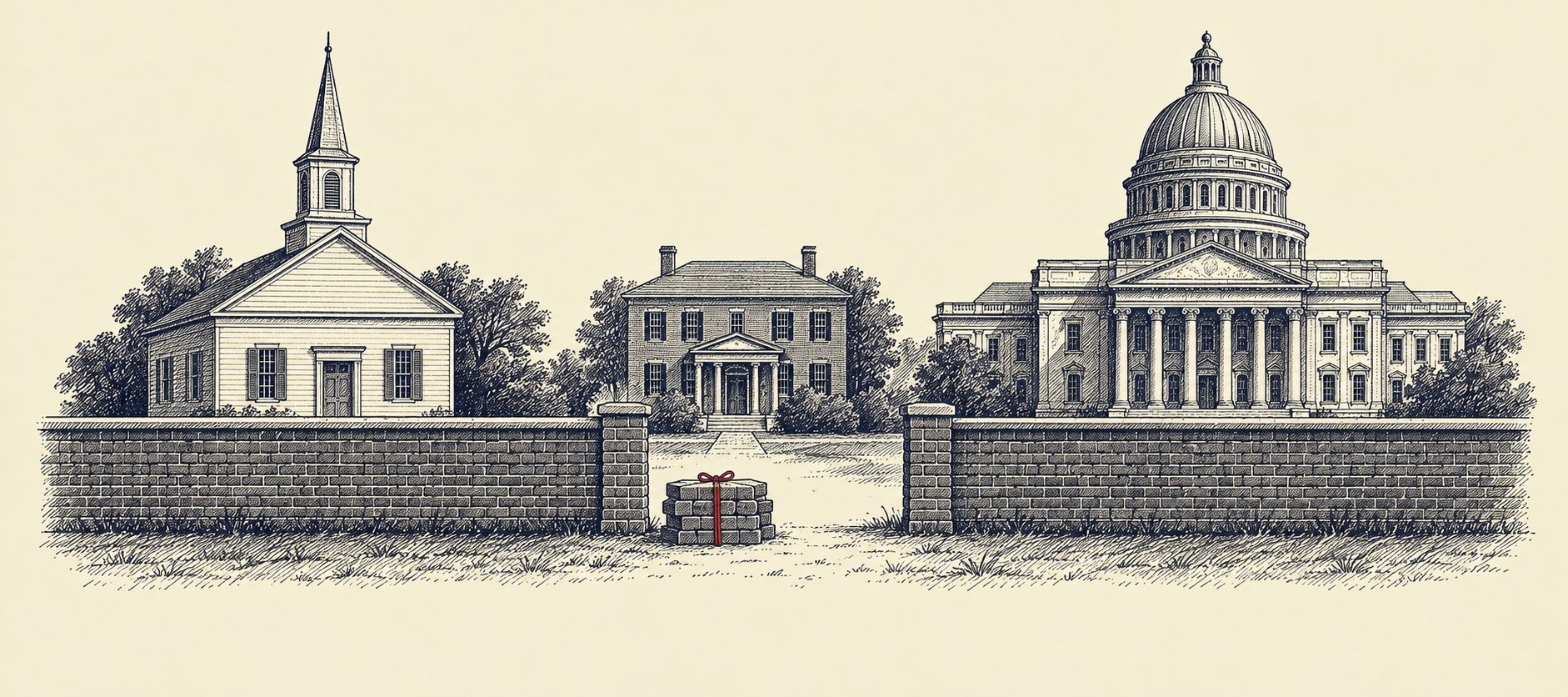
In 1791 the United States did something few governments in history had chosen to do. It forbade itself to establish a religion. Not because the founders were indifferent to faith, but because they had seen what happened when the state could tell a person what to believe about the most important things, and enforce it.
They built a wall. They did not build one around the body.
They had little reason to. Medicine in 1791 was local, plural and modest. It made no claim on the whole of life. It did not issue passports, close churches, set the conditions of employment, or decide which questions about a drug a citizen could ask in public. It does all of those things now, and it does them with an authority that looks, on inspection, a great deal like the authority the founders took away from the churches.
This essay is about that resemblance, and about the wall that is missing. Its argument fits in three sentences:
There is no medical freedom without consent. There is no consent without information. There is no information without free speech.
Everything Restore the First does follows from those three sentences. So does most of what I have written over eighteen years. I want to set the argument down whole, in one place, with its sources, so that it can be checked.
Story at a glance
- The idea of separating medicine from state is not new. The psychiatrist Thomas Szasz argued for it from 1963 until his death. What is new is how much medicine now claims.
- Medicine has taken on the structure of a religion: a priesthood, a doctrine of salvation, rituals of belonging, and heretics. The philosopher Giorgio Agamben made this argument in May 2020. I had made a version of it in 2012.
- Michel Foucault described how modern power came to govern people as a population, a biological mass, rather than as persons. Agamben described what happens when that power governs through permanent emergency. I call the resulting doctrine biocollectivism: the belief that your body is held in trust for a collective body that experts define and the state administers.
- A single causal story about disease, the invisible enemy that could be in anyone, is what turns biocollectivism from a philosophy into a warrant. That is a political point, not a claim that germs do not exist.
- The Nuremberg Code’s first principle requires that a person have “sufficient knowledge and comprehension” to make an “enlightened decision.” Consent is an information right. Censoring health information removes the precondition of consent itself.
- Separation does not abolish medicine, any more than the First Amendment abolished churches. It ends the state’s power to compel it, and the state’s power to decide what may be said about it.
A wall Szasz drew first
The phrase is not mine. Thomas Szasz, the psychiatrist who spent half a century opposing coercive psychiatry, called it the “therapeutic state” in 1963 and argued for a wall between medicine and government as solid as the one between church and government. His statement of the problem has not been bettered:
“The Founders sought to protect the American people from the religious tyranny of the State. They did not anticipate, and could not have anticipated, that one day medicine would become a religion and that the alliance between medicine and the State would then threaten personal liberty and responsibility exactly as they had been threatened by the alliance between church and State.”
And the task, as he put it: “separating the consensual treatment of patients by medical doctors from the coercive control of persons by agents of the State pretending to be healers” (Szasz, The Freeman).
A note before going further, because accuracy is the whole point of this essay. You may have seen a line attributed to Benjamin Rush, signer of the Declaration, warning that “unless we put medical freedom into the Constitution, the time will come when medicine will organize into an undercover dictatorship.” I have quoted it myself. Rush never wrote it. The University of Pennsylvania’s Rush portal traces it to an 1899 speech, embellished in medical journals over the following two decades (Penn Libraries), and it was Szasz who first exposed it. The argument for a wall does not need a borrowed founder. It needs the record of what medicine has become.
The religion that devours the others
In 2012 I wrote that “medical science has laid claim to the body in the same way that religions once laid claim to the soul,” and that the physician had become “the ‘priest of the body’” (GreenMedInfo). I meant it structurally, not as an insult to physicians, many of whom are the first to resent the role. A system that holds there is “one truth, and one right way to apply it,” and that grants absolute authority to those who claim to know the difference, has the shape of a church whatever it calls itself.
Eight years later, in the first weeks of the pandemic, Giorgio Agamben took the argument further than I had. In “Medicine as Religion,” published May 2, 2020, he observed that the modern West had lived with three great systems of belief, Christianity, capitalism and science, in uneasy coexistence. What was new, he wrote, was “a subterranean and implacable conflict” between science and the other two, fought not over doctrine but over practice. Its protagonist was medicine, “whose immediate object is the living body of human beings” (Agamben, trans. Adam Kotsko).
Agamben named the features. A Manichean dualism: a malign principle, disease, whose agents are bacteria and viruses, and a beneficent one that is “not health, but recovery.” A cult that had always been episodic, a visit, a prescription, an operation, and had suddenly become “permanent and all-pervasive,” so that “the whole life of human beings must become in every instant the place of an uninterrupted cultic celebration.” And, for the first time, a cult that was no longer “free and voluntary” but “rendered normatively obligatory,” enforced by the state “point by point in deeds.”
That is the sense in which medicine became the religion that devours the others. Churches were closed by order while the medical liturgy was made compulsory. Commerce absorbed losses it had never accepted for any cause. And the new faith brought something the old ones had allowed to lapse: an eschatological urgency without a promise of redemption, because the enemy “cannot be eliminated once and for all, but mutates continually.”
A religion needs heretics. Ours had one ready-made. “Anti-vaxxer” was never a description; it was, as I wrote last year, “a modern brand of heresy,” a mark placed on anyone who “refused to submit to an emergent biopolitical orthodoxy” (The Fall of a Weaponized Term). The word did the work an argument would otherwise have had to do. It still does. As I put it this summer, “real science welcomes dissent. Only a religion needs heretics” (They Gave Fauci Due Process. They Gave Us a List.).
From sovereignty to biopower
Why does this matter for politics, and not only for medicine? Michel Foucault gave the answer in a lecture at the Collège de France on March 17, 1976.
The old power of the sovereign, he said, was “the right to take life or let live.” Modern power added its opposite: “the power to ‘make’ live and ‘let’ die.” And it took a new object. After disciplining individual bodies, power made “a second seizure” that was “not individualizing but, if you like, massifying, that is directed not at man-as-body but at man-as-species.” Foucault called it “biopolitics.” It governs birth rates, mortality, illness and the environment through “forecasts, statistical estimates, and overall measures” (Society Must Be Defended, lecture of 17 March 1976).
The patient of biopolitics is not you. It is the population. You appear in it as a data point, a risk, a rate.
Agamben’s contribution was to show what happens when biopolitics governs through emergency. Writing on February 26, 2020, he described “the tendency to use a state of exception as a normal paradigm for government,” and warned that “with terrorism exhausted as a cause for exceptional measures, the invention of an epidemic offered the ideal pretext for scaling them up beyond any limitation” (European Journal of Psychoanalysis). By May, drawing on the historian of medicine Patrick Zylberman, he described a paradigm he called biosecurity, with three features: a fictional scenario built from a possible risk; “the logic of the worst” adopted as a regime of political rationality; and the integral organization of the body of citizens, in which “imposed obligations are presented as evidence of altruism” and the citizen becomes “juridically obliged to health” (“Biosecurity and Politics,” May 11, 2020, as translated in Pandemic Power).
Agamben paid for these essays, and some of the criticism was fair. His February 2020 description of the disease did not survive the evidence, and his comparisons to fascism were overdrawn. In my white paper on pandemic governance I set out those criticisms in full before arguing that four of his insights hold anyway: emergency powers really were normalized without legislative or judicial oversight in many countries; fear really was used as an instrument of compliance; governing for a single cause of death really did discount every other kind of suffering; and emergency infrastructure really did outlast the emergency (Endless Pandemics as a Failed Global Governance Model). That is the defensible version. It does not need a conspiracy. It needs only the documented tendency of emergency power to keep the ground it takes.
The tendency is not historical. On October 12, 2026, the UN General Assembly adopted a pandemic declaration by 153 votes to 3. Its paragraph 57 commits governments to “take measures to counter and address” health “misinformation, disinformation.” It defines neither term. It sets no limits on the measures. And it never mentions freedom of expression, privacy or informed consent (153 Nations Just Voted for the Permanent Emergency).
Biocollectivism
The name I give to the doctrine underneath all of this is biocollectivism.
Biocollectivism holds that the individual body is held in trust for a collective body, and that the collective body is defined by experts and administered by the state. Your body is yours, provisionally, until the collective has a use for it. Then it is the herd’s.
I described this in 2025 without the word. During the pandemic, “individual sovereignty was subsumed by the demands of an imagined collective body. This collectivism, however, was not true community. True community thrives on informed consent, dialogue, diversity of thought, and mutual respect. What we witnessed instead was a form of ideological socialism, where individual differences were not tolerated but eradicated in the name of a falsely universal good” (The Fall of a Weaponized Term).
I use “collectivism” and “socialism” here structurally, not as party labels. The structure is old and has never belonged to one side of politics. Its signature is the transfer of ownership: what was a person’s becomes the collective’s, and a class of administrators decides how it is used. Classical collectivism claimed the means of production. Biocollectivism claims the means of biological life. Its currency is the “greater good”; its unit of account is the population Foucault described; its ledger is the risk model.
American law has already shown where this logic leads. In 1905, in Jacobson v. Massachusetts, the Supreme Court upheld a five-dollar fine for refusing a smallpox vaccine, reasoning that there are “manifold restraints to which every person is necessarily subject for the common good.” Twenty-two years later Justice Oliver Wendell Holmes needed a precedent for forcibly sterilizing a young woman named Carrie Buck. He found it in Jacobson: “The principle that sustains compulsory vaccination is broad enough to cover cutting the Fallopian tubes. Three generations of imbeciles are enough” (Buck v. Bell, 274 U.S. 200, 207 (1927)).
That sentence is the whole danger of biocollectivism in fifteen words. A principle written to justify a fine for the herd’s sake was, within one generation, broad enough to justify a scalpel. Principles do not stay where they are put.
The invisible enemy as warrant
Every collectivism needs an account of the threat that justifies it. For biocollectivism, that account is the war model of disease: an invisible enemy, outside us, that could be carried by anyone. If anyone may be the vector, then everyone may be governed as a suspect. That is the political work the war metaphor does, and it is why I have written that without a nineteenth-century germ theory “still treated as dogma despite its provisional nature,” the world “would not have been locked down,” and the leverage to compel billions into accepting a novel injection “simply would not have existed” (X, Sept. 30, 2025).
That sentence is easy to misread, so let me be exact. The political argument does not depend on denying that infection exists. My own investigative series on the subject says so in its first pages: its purpose “is not simply to replace germ theory with an equally narrow toxin-only theory. It is to widen the field of causation,” and its general thesis is “compatible with the existence of viruses.” Its first principle is that “detection is not the same as complete causation”: a pathogen may be present and active and still be only one part of an illness shaped by the terrain that receives it, the lifetime of exposures that preceded it, and the body’s own signals in response (Poisoned, Not Infected).
The biology points the same way. We are holobionts. Take away the bacteria, fungi and viruses that live with and within us, and “only 1% of the genetic material that keeps us ticking” remains. As germs become “less other and more self,” the line between the good microbes we are and the bad ones out there becomes harder to draw (GreenMedInfo). A body that is mostly “other” is a poor foundation for a politics of the enemy within.
Even the word betrays the politics. Immunity comes from the Latin immunis: exempt from the munus, the obligation or gift held in common, the same munus that gives us community. The Italian philosopher Roberto Esposito built a philosophy on that etymology (Esposito, Crisis and Critique). Biocollectivism inverts it. It makes immunity the price of community, and treats the person who declines the price as having forfeited membership.
The point is narrow and it is political. One causal story about disease, held with the certainty of doctrine, cannot be allowed to become a standing warrant to suspend everyone’s rights. Science can hold its theories provisionally. A constitution cannot be held provisionally on their behalf.
Consent is an information right
The founding document of modern medical ethics was written in a courtroom. In 1947, judging physicians who had experimented on prisoners, the tribunal at Nuremberg set out ten principles. The first is the longest, and its final clause is the one that matters here:
“The voluntary consent of the human subject is absolutely essential. This means that the person involved should have legal capacity to give consent; should be so situated as to be able to exercise free power of choice, without the intervention of any element of force, fraud, deceit, duress, over-reaching, or other ulterior form of constraint or coercion; and should have sufficient knowledge and comprehension of the elements of the subject matter involved as to enable him to make an understanding and enlightened decision.”
(New England Journal of Medicine, “Fifty Years Later: The Significance of the Nuremberg Code”.) The International Covenant on Civil and Political Rights carried the principle into treaty law: “no one shall be subjected without his free consent to medical or scientific experimentation” (ICCPR, Article 7). Article 7 is one of the covenant’s non-derogable rights. No emergency suspends it.
Read the Nuremberg clause again. Consent is not a signature. It has two parts, and the second is knowledge. A person who has been denied the information needed for an “enlightened decision” has not consented, however freely they signed. Coercion and censorship are therefore not two separate wrongs. They are the two ways of defeating the same right: one removes the choice, the other removes the knowledge the choice requires.
I built GreenMedInfo on that premise in 2008 and said so plainly when it was first targeted for removal: “Informed consent depends entirely on two things: 1) information that accurately communicates the benefits and risks of interventions, and what available treatments exist... 2) on your full consent to the procedure, once you have been properly informed.” And: “Information is the currency of democracy... without free access to this democratic life blood, informed consent can not be made available nor practiced” (GreenMedInfo Founder’s Statement, 2019).
This is why censorship of health information is not a speech problem that happens to involve medicine. It is a medical-ethics problem that happens to require speech. When a list of twelve Americans is used to justify removing them from the platforms where people look for health information, and the company that removed them later finds the list’s central number overstated by a factor of at least 1,300 (Twelve Names), what was lost was not only their speech. It was some part of every reader’s capacity to consent.
Free speech, in other words, is not adjacent to medical freedom. It is its first condition.
What separation would mean
The First Amendment did not abolish churches. It did not stop anyone from believing, worshipping, preaching or persuading. It removed one thing: the state’s power to compel belief and to punish dissent from it. Churches flourished after disestablishment, because faith that is chosen is stronger than faith that is enforced.
Separating medicine from state would work the same way. It would not abolish medicine, or public health, or the physician’s authority to advise. It would remove the state’s power to compel medical acts and to police what may be said about them. Concretely, it means seven commitments:
- Consent is non-derogable. No emergency suspends the right to refuse a medical intervention, consistent with ICCPR Article 7.
- No jawboning of health speech. No government pressure on platforms or publishers to remove lawful speech about health. This is the purpose of the JAWBONE Act.
- Emergencies end. Emergency powers carry sunset clauses renewable only by legislative vote, under real-time judicial review, measured against the necessity and proportionality tests of the Siracusa Principles.
- No medical condition on civic life. Access to work, school, travel, worship and public life is not conditioned on a medical act.
- Follow the money. Public disclosure of private and philanthropic funding of health authorities and the organizations that advise them on “misinformation.” See Who Funds CCDH.
- Plural medicine. The right to choose one’s practitioner and one’s remedies, and to hear the evidence for each.
- A remedy when it is violated. A private right of action for anyone whose speech or bodily autonomy is violated under color of law. See the First Amendment Remedies Act.
None of these is radical. Each is already law somewhere, or a principle governments have signed. What has never existed is the wall that joins them.
The body is the first jurisdiction
Every freedom the founders protected presupposes one they did not write down: that a person’s body is their own. You cannot speak freely if your conscience can be overridden at the skin. You cannot worship freely if the state may decide what enters your bloodstream as the price of entering the sanctuary. You cannot consent to anything if you are forbidden to learn what you are consenting to.
I made this case in April 2025, and I will not improve on the sentence I opened it with: “Your body is not a permission slip.” In legal terms, I wrote, “your body is a jurisdiction—a domain in which the state has no authority without due process, informed consent, and narrowly defined justification.” Its boundaries already run through the Constitution: the Fourth Amendment against unwarranted intrusion, the First for conscience and belief, the Ninth and Tenth for unenumerated rights such as the right to refuse a medical procedure, the Fourteenth for due process and equal protection (Reclaiming the Body: A Constitutionally Protected Domain; see also The Legal and Constitutional Basis for Health Sovereignty). What those amendments do not yet do is join. The separation of medicine from state is the name for joining them.
The founders built their wall around the soul because, in their century, the soul was what power wanted. In ours, power wants the body, and it asks for it in the language of care. That is exactly why the wall is needed. Dangerous ideas, as I wrote this summer, “never arrive announcing themselves as evil. They arrive as improvement. As safety. As progress” (X, Aug. 22, 2026).
The bricks are stacked beside the gap. It is time to finish the wall.